Tendring Topics……on line
Some good news!
Yes, there is some good news for a change. What’s more, it’s good news for Clacton! The recession has cost the town some of its best-known and, it might have been thought, most firmly based businesses. There was the Co-op Departmental Store in Station Road – Clacton’s only departmental store. There was the well-stocked and welcoming Comet Store on the Waterglade retail park off Old Road, the furniture store on the corner of West Avenue and Agate Road, ‘Eyewear’, the opticians on the corner of High Street and Beach Road who had dealt with my optical needs for many years, and Woolworth, fronting onto both Pier Avenue and West Avenue, a national as well as a local institution. There were smaller businesses; the video hire shop almost opposite the former St Osyth Road Infants’ school which I passed by in my mobility scooter almost every day. I could go on.
 Some of those gaps have been refilled. Woolworth’s site is now being used by the 99p Store; a business new to the town that never seems to be short of customers. The Co-op Departmental Store was taken over by Vergo. They seemed promising but went into liquidation after only a few months. The Black Bull pub in St Osyth Road was demolished to make way for a Tesco Express.
Other more recent developments have already produced a welcome 60 new jobs with the possibility of more on the way. The carpet shop in West Avenue has been redeveloped as Baldwin’s Department Store. The Proprietor, Kevin Baldwin from Harwich had been the Manager of Vergo and has taken on some of Vergo’s redundant staff. On the Waterglade retail park the former Comet Store is now a branch of NEXT a well-known clothing and homeware chain.
In Jackson Road a branch of Coffee Republic is opening up in April next to the Travelodge Hotel, while on the other side of the road Rock-a-bye Baby, a baby clothes shop has just opened.
Will the young and newly born enterprises adequately replace those that have disappeared? One day perhaps – but not yet I am afraid. The 99p Store, popular as it is, hardly takes the place of Woolworth’s. I haven’t yet had a chance to look in at NEXT, in Waterglade Business Park, but I have been into Baldwin’s Department Store.
Welcoming as the staff were, I didn't feel that it in any way compared with either the Co-op Store or the Vergo Store that replaced it. Still, these new businesses provided some badly needed jobs and the Clacton Gazette, ever optimistic, sees them as the first green shoots of recovery. Perhaps they are. If so, I hope that they are not strangled by rising inflation, rising unemployment and the VAT increase, before they have a chance to develop.
And some more good news – well, sort of!
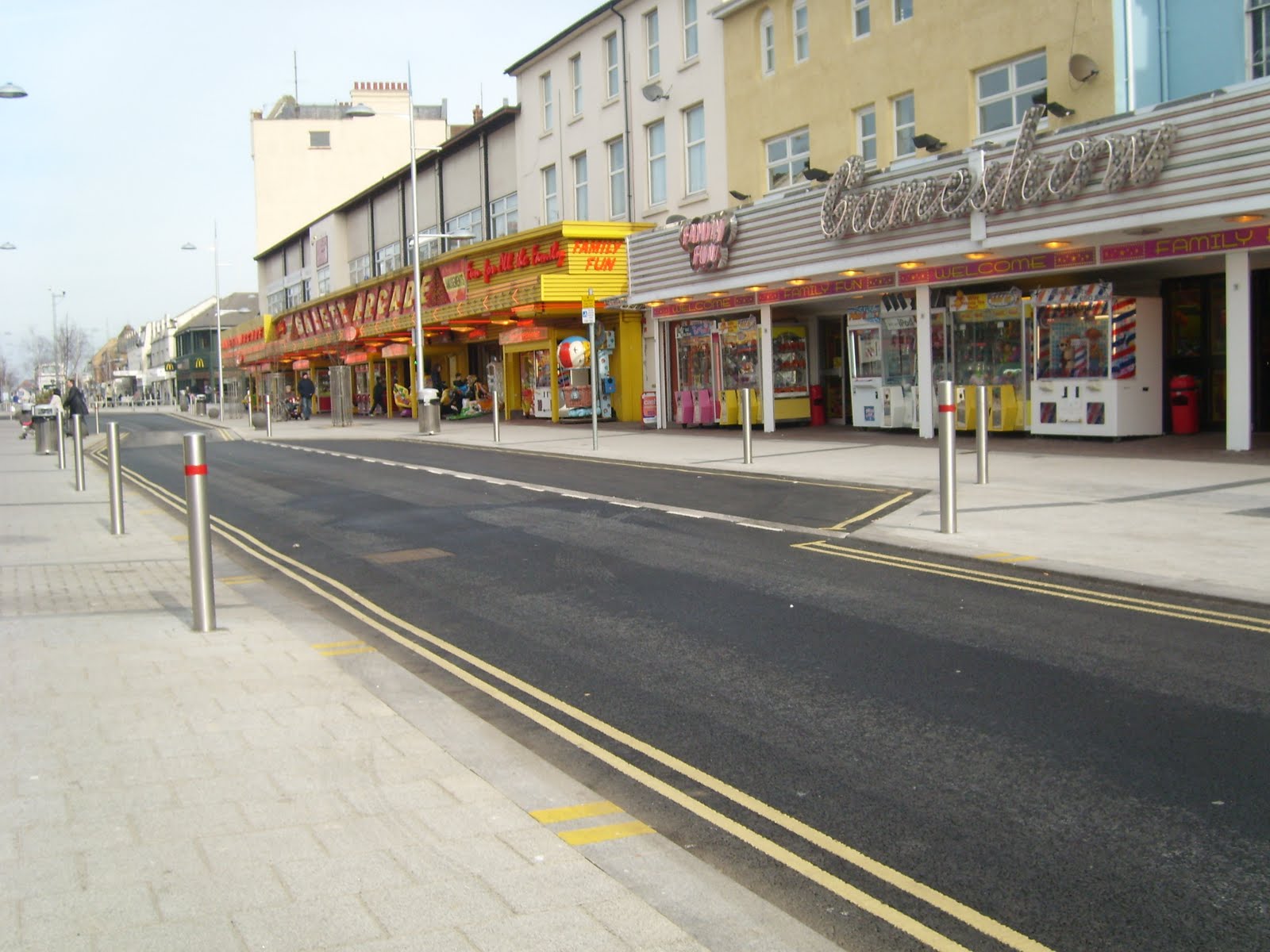
The redevelopment of the seaward stretch of Pier Avenue has at long last been completed. Pavements have been widened and the carriageway narrowed to make it strictly ‘a single carriageway’. It was work that was supposed to have been finished before Christmas but the appalling weather in December put it back, to the consternation of the very traders whom the improvement was supposed to benefit. They complained that they had lost custom because of the long-winded building work and the reduction of access to their businesses that had resulted.
Here is the result. It was a section of Pier Avenue on which the dust had hardly settled since the previous reconstruction that had been carried out with the same purpose! I suppose that it is an improvement but surely, in a time of austerity, it was hardly worth the time, the money, the energy and the disruption that went into it.
The money, and the workmen’s time, would have been better spent seeking out (they’re not hard to find!) and repairing the potholes in Clacton’s roads and the broken, uneven and dangerous pavements away from the town centre. It wouldn’t have been a glamorous or headline-making enterprise but, I think, one of much more real value to we Clactonians.
‘Labour isn’t working!’
Remember that message on a pre-election hoarding long ago? It was illustrated by a dole queue disappearing into the distance. Then, I think, the number of unemployed was more than a million. Nowadays there are two and a half million unemployed, and the number is rising. The Private Sector has failed to absorb the job losses resulting from cuts in the Public Sector. The ‘experts’ were surprised and disappointed. I wasn’t.
It had been obvious to me that, as I have pointed out repeatedly in this blog, there had never been a chance that it would. Successive governments have compelled local and Health Authorities to get rid of their direct labour forces and put their services out to private contractors. One consequence has been that hospitals no longer employ their own cleaners who were known to the other hospital staff and the long-term patients, and who took a real pride in keeping their wards spotlessly clean. They now have to use the employees of contractors, to whom cleaning a hospital ward is ‘just another job’ for which they get as much as they can for as little effort as they can get away with. That’s the way of today’s world.
Another consequence has been to make it impossible to force economies on the public sector without similarly affecting the private. When, for instance, a local authority decides to save money by switching from a weekly refuse collection to a fortnightly one, it is the private firm actually undertaking the collection that suffers. Building maintenance firms, providers of meals-on-wheels, Hospital caterers, cleaners, a wide range of consultants (all part of the Private Sector) and many others, stand to suffer. Their problems may not arrive immediately. Contracts have to run their course. However, come they inevitably will.
I fear that unemployment has not yet peaked.
Prophecies of doom and gloom!
I don’t know how many times I have published my thoughts on the probable course of future events in this blog and have added that I hoped most profoundly that I was wrong. Cassandra probably felt the same way when she predicted the destruction of Troy! She was right, and all too often I have been right too.
I have been proved right in believing that the Private Sector couldn’t possibly find employment for those rendered redundant by Public Service Cuts. It seems that I was right too in my belief that students financing their years of study with government loans would face a lifetime of intolerable debt. It now appears that the better-paid graduates’ careers become, the more likely it is that throughout their working lives (the time in which they are likely to marry, have and bring up children, repay a mortgage on their homes, buy and run a car, and so on) they will be paying off that debt from their undergraduate days. Those who complete the repayment and clear their debt will find that by that time they have repaid twice as much as they originally borrowed!
I have always believed that nuclear energy production is fraught with unacceptable risks. My particular concern was that it had a particularly dangerous waste product that remained lethal for hundreds of years – and for which no-one had so far produced a safe and satisfactory means of disposal. The experience of Three Mile Island, Windscale, Chernobyl – and now Japan, indicates that operating nuclear plant can produce more immediate perils. No-one can tell when and how the present crisis in Japan will end.
Clacton, and the greater part of the Tendring peninsula lie well within the danger zone of Bradwell Nuclear power station, which may well be brought back into
use in the next few years. Sizewell, in Suffolk and just a few miles up the coast, isn’t very far way.
Bradwell is most unlikely to experience either an earthquake or a tsunami, though it should be remembered that the most damaging English earthquake recorded in at least the past 500 years took place in the Colchester area in 1884! Over 1,000 buildings were damaged, in Colchester, Wivenhoe (the epicentre, where every house was damaged!) and other settlements between Colchester and Ipswich.
I think though that Bradwell’s chief danger is its vulnerability to terrorist attack, perhaps as a commando style raid using inflatable craft launched from an apparently harmless fishing boat moored a mile or two out-to-sea.
I very much hope that I am never in a position to say, ‘I told you so!’
A Prophecy that failed – or did it?
A week or two ago I said that my best guess about the unfolding crisis in Libya was that the United Nations would ultimately sanction a ‘No-fly’ zone over Libya but that this decision would come too late to prevent the slaughter of scores of innocent men and women when Gaddafi’s troops captured the remaining insurgent strongholds. I was wrong. In the end the Security Council acted swiftly. As, despite the promise of an immediate ceasefire, Gaddafi’s forces launched an attack on Benghazi, French and British planes began bombing military targets and the American navy, using Cruise Missiles has joined in.
I am left with a feeling of profound sadness. It is easy enough to start a war but, as we are finding in Afghanistan, far more difficult to end it. Perhaps this one will be the exception. Perjhaps Gaddafi’s forces will decline to fight a war that they must surely lose in the end, and will oust their leader. Perhaps, but both in August 1914 and in September 1939 there were those who insisted that ‘The war will be over by Christmas!’ When Hitler invaded the USSR in June 1941 he was sure that a few victorious battles would swiftly bring about the collapse of the Soviet regime.
As with the blitz in England, air attacks are just as likely to unite the country in anger and thirst for retaliation as to induce despair. Western intervention will inevitably bring accusations, however unjustified, that this is another ‘crusade’ aimed at destroying Islam. Like the wars in Iraq and Afghanistan it will bring joy to the hearts of those who are grooming young Muslims for recruitment into terrorist organisations. The probability of terrorist attacks in Europe and the USA will increase.
A war in the Libyan Desert will inevitably bring a very serious risk of casualties from ‘friendly fire’ among both civilians and combatants. Both sides discovered that in the war in which I was engaged in 1941/’42. There were no defined front lines and a surprise attack could come from any direction. Both sides were making use of captured vehicles, and the desert uniforms of the opposing armies were not readily distinguishable. On many occasions army vehicles, lost in the desert (in a dust storm perhaps) would spot an army convoy that they fondly imagined was ‘one of ours’ and discover too late it was, in fact, one of the enemy’s. This encourages nervous soldiers to ‘fire first and identify the bodies later!’ In the present conflict all military vehicles and heavy weapons used by the insurgents will have been captured from the Libyan Army.
One such friendly fire incident has already occurred. On the very day that the Security Council made its fateful decision, the defenders of Benghazi were jubilant at having shot down in flames a Libyan Air Force plane. Sadly it was, in fact, a plane whose pilot had defected to the insurgency.
The support of western intervention by the Arab League is said to have been an important factor in the Security Council’s decision. It has certainly landed us with some very strange allies in the struggle against Gaddafi! Members of the Arab League include Bahrain, whose ruler has brought in foreign troops to brutalise the peaceful but determined majority who oppose his rule. These foreign troops came from Saudi Arabia, a leading member of the League and a land where the practice of religion other than Islam is strictly prohibited, public floggings and beheadings are part of the criminal law, and women are treated in a way that we in the west would regard as intolerable. Then there is Yemen where we have learned that pro-government snipers have shot and killed a number of peaceful protesters congregating after Friday prayers in a public square.
Those countries are certainly not the first that come to mind as enthusiastic supporters of a campaign to bring freedom and democracy to the benighted land of Libya! They do, of course, have one thing in common. Their autocratic rulers have remained in power for as long as they have with the generous support of Britain and the USA.
I hope and pray, though without a great deal of conviction, that this conflict will swiftly end, and that Libya, together with newly self-liberated Egypt and Tunisia, will prove that Arab and Islamic states can develop into liberal and tolerant democracies.
Some good news!
Yes, there is some good news for a change. What’s more, it’s good news for Clacton! The recession has cost the town some of its best-known and, it might have been thought, most firmly based businesses. There was the Co-op Departmental Store in Station Road – Clacton’s only departmental store. There was the well-stocked and welcoming Comet Store on the Waterglade retail park off Old Road, the furniture store on the corner of West Avenue and Agate Road, ‘Eyewear’, the opticians on the corner of High Street and Beach Road who had dealt with my optical needs for many years, and Woolworth, fronting onto both Pier Avenue and West Avenue, a national as well as a local institution. There were smaller businesses; the video hire shop almost opposite the former St Osyth Road Infants’ school which I passed by in my mobility scooter almost every day. I could go on.
 Some of those gaps have been refilled. Woolworth’s site is now being used by the 99p Store; a business new to the town that never seems to be short of customers. The Co-op Departmental Store was taken over by Vergo. They seemed promising but went into liquidation after only a few months. The Black Bull pub in St Osyth Road was demolished to make way for a Tesco Express.
Other more recent developments have already produced a welcome 60 new jobs with the possibility of more on the way. The carpet shop in West Avenue has been redeveloped as Baldwin’s Department Store. The Proprietor, Kevin Baldwin from Harwich had been the Manager of Vergo and has taken on some of Vergo’s redundant staff. On the Waterglade retail park the former Comet Store is now a branch of NEXT a well-known clothing and homeware chain.
In Jackson Road a branch of Coffee Republic is opening up in April next to the Travelodge Hotel, while on the other side of the road Rock-a-bye Baby, a baby clothes shop has just opened.
Will the young and newly born enterprises adequately replace those that have disappeared? One day perhaps – but not yet I am afraid. The 99p Store, popular as it is, hardly takes the place of Woolworth’s. I haven’t yet had a chance to look in at NEXT, in Waterglade Business Park, but I have been into Baldwin’s Department Store.
Welcoming as the staff were, I didn't feel that it in any way compared with either the Co-op Store or the Vergo Store that replaced it. Still, these new businesses provided some badly needed jobs and the Clacton Gazette, ever optimistic, sees them as the first green shoots of recovery. Perhaps they are. If so, I hope that they are not strangled by rising inflation, rising unemployment and the VAT increase, before they have a chance to develop.
And some more good news – well, sort of!
The redevelopment of the seaward stretch of Pier Avenue has at long last been completed. Pavements have been widened and the carriageway narrowed to make it strictly ‘a single carriageway’. It was work that was supposed to have been finished before Christmas but the appalling weather in December put it back, to the consternation of the very traders whom the
 improvement was supposed to benefit. They complained that they had lost custom because of the long-winded building work and the reduction of access to their businesses that had resulted.
Here is the result. It was a section of Pier Avenue on which the dust had hardly settled since the previous reconstruction that had been carried out with the same purpose! I suppose that it is an improvement but surely, in a time of austerity, it was hardly worth the time, the money, the energy and the disruption that went into it.
The money, and the workmen’s time, would have been better spent seeking out (they’re not hard to find!) and repairing the potholes in Clacton’s roads and the broken, uneven and dangerous pavements away from the town centre. It wouldn’t have been a glamorous or headline-making enterprise but, I think, one of much more real value to we Clactonians.
‘Labour isn’t working!’
Remember that message on a pre-election hoarding long ago? It was illustrated by a dole queue disappearing into the distance. Then, I think, the number of unemployed was more than a million. Nowadays there are two and a half million unemployed, and the number is rising. The Private Sector has failed to absorb the job losses resulting from cuts in the Public Sector. The ‘experts’ were surprised and disappointed. I wasn’t.
It had been obvious to me that, as I have pointed out repeatedly in this blog, there had never been a chance that it would. Successive governments have compelled local and Health Authorities to get rid of their direct labour forces and put their services out to private contractors. One consequence has been that hospitals no longer employ their own cleaners who were known to the other hospital staff and the long-term patients, and who took a real pride in keeping their wards spotlessly clean. They now have to use the employees of contractors, to whom cleaning a hospital ward is ‘just another job’ for which they get as much as they can for as little effort as they can get away with. That’s the way of today’s world.
Another consequence has been to make it impossible to force economies on the public sector without similarly affecting the private. When, for instance, a local authority decides to save money by switching from a weekly refuse collection to a fortnightly one, it is the private firm actually undertaking the collection that suffers. Building maintenance firms, providers of meals-on-wheels, Hospital caterers, cleaners, a wide range of consultants (all part of the Private Sector) and many others, stand to suffer. Their problems may not arrive immediately. Contracts have to run their course. However, come they inevitably will.
I fear that unemployment has not yet peaked.
Prophecies of doom and gloom!
I don’t know how many times I have published my thoughts on the probable course of future events in this blog and have added that I hoped most profoundly that I was wrong. Cassandra probably felt the same way when she predicted the destruction of Troy! She was right, and all too often I have been right too.
I have been proved right in believing that the Private Sector couldn’t possibly find employment for those rendered redundant by Public Service Cuts. It seems that I was right too in my belief that students financing their years of study with government loans would face a lifetime of intolerable debt. It now appears that the better-paid graduates’ careers become, the more likely it is that throughout their working lives (the time in which they are likely to marry, have and bring up children, repay a mortgage on their homes, buy and run a car, and so on) they will be paying off that debt from their undergraduate days. Those who complete the repayment and clear their debt will find that by that time they have repaid twice as much as they originally borrowed!
I have always believed that nuclear energy production is fraught with unacceptable risks. My particular concern was that it had a particularly dangerous waste product that remained lethal for hundreds of years – and for which no-one had so far produced a safe and satisfactory means of disposal. The experience of Three Mile Island, Windscale, Chernobyl – and now Japan, indicates that operating nuclear plant can produce more immediate perils. No-one can tell when and how the present crisis in Japan will end.
Clacton, and the greater part of the Tendring peninsula lie well within the danger zone of Bradwell Nuclear power station, which may well be brought back into
use in the next few years. Sizewell, in Suffolk and just a few miles up the coast, isn’t very far way.
Bradwell is most unlikely to experience either an earthquake or a tsunami, though it should be remembered that the most damaging English earthquake recorded in at least the past 500 years took place in the Colchester area in 1884! Over 1,000 buildings were damaged, in Colchester, Wivenhoe (the epicentre, where every house was damaged!) and other settlements between Colchester and Ipswich.
I think though that Bradwell’s chief danger is its vulnerability to terrorist attack, perhaps as a commando style raid using inflatable craft launched from an apparently harmless fishing boat moored a mile or two out-to-sea.
I very much hope that I am never in a position to say, ‘I told you so!’
A Prophecy that failed – or did it?
A week or two ago I said that my best guess about the unfolding crisis in Libya was that the United Nations would ultimately sanction a ‘No-fly’ zone over Libya but that this decision would come too late to prevent the slaughter of scores of innocent men and women when Gaddafi’s troops captured the remaining insurgent strongholds. I was wrong. In the end the Security Council acted swiftly. As, despite the promise of an immediate ceasefire, Gaddafi’s forces launched an attack on Benghazi, French and British planes began bombing military targets and the American navy, using Cruise Missiles has joined in.
I am left with a feeling of profound sadness. It is easy enough to start a war but, as we are finding in Afghanistan, far more difficult to end it. Perhaps this one will be the exception. Perjhaps Gaddafi’s forces will decline to fight a war that they must surely lose in the end, and will oust their leader. Perhaps, but both in August 1914 and in September 1939 there were those who insisted that ‘The war will be over by Christmas!’ When Hitler invaded the USSR in June 1941 he was sure that a few victorious battles would swiftly bring about the collapse of the Soviet regime.
As with the blitz in England, air attacks are just as likely to unite the country in anger and thirst for retaliation as to induce despair. Western intervention will inevitably bring accusations, however unjustified, that this is another ‘crusade’ aimed at destroying Islam. Like the wars in Iraq and Afghanistan it will bring joy to the hearts of those who are grooming young Muslims for recruitment into terrorist organisations. The probability of terrorist attacks in Europe and the USA will increase.
A war in the Libyan Desert will inevitably bring a very serious risk of casualties from ‘friendly fire’ among both civilians and combatants. Both sides discovered that in the war in which I was engaged in 1941/’42. There were no defined front lines and a surprise attack could come from any direction. Both sides were making use of captured vehicles, and the desert uniforms of the opposing armies were not readily distinguishable. On many occasions army vehicles, lost in the desert (in a dust storm perhaps) would spot an army convoy that they fondly imagined was ‘one of ours’ and discover too late it was, in fact, one of the enemy’s. This encourages nervous soldiers to ‘fire first and identify the bodies later!’ In the present conflict all military vehicles and heavy weapons used by the insurgents will have been captured from the Libyan Army.
One such friendly fire incident has already occurred. On the very day that the Security Council made its fateful decision, the defenders of Benghazi were jubilant at having shot down in flames a Libyan Air Force plane. Sadly it was, in fact, a plane whose pilot had defected to the insurgency.
The support of western intervention by the Arab League is said to have been an important factor in the Security Council’s decision. It has certainly landed us with some very strange allies in the struggle against Gaddafi! Members of the Arab League include Bahrain, whose ruler has brought in foreign troops to brutalise the peaceful but determined majority who oppose his rule. These foreign troops came from Saudi Arabia, a leading member of the League and a land where the practice of religion other than Islam is strictly prohibited, public floggings and beheadings are part of the criminal law, and women are treated in a way that we in the west would regard as intolerable. Then there is Yemen where we have learned that pro-government snipers have shot and killed a number of peaceful protesters congregating after Friday prayers in a public square.
Those countries are certainly not the first that come to mind as enthusiastic supporters of a campaign to bring freedom and democracy to the benighted land of Libya! They do, of course, have one thing in common. Their autocratic rulers have remained in power for as long as they have with the generous support of Britain and the USA.
I hope and pray, though without a great deal of conviction, that this conflict will swiftly end, and that Libya, together with newly self-liberated Egypt and Tunisia, will prove that Arab and Islamic states can develop into liberal and tolerant democracies.