Showing posts with label unemployment. Show all posts

25 January 2012

Week 4 2012

Tendring Topics..........on Line


‘When the Bon Marché was shuttered…….’

            ……..When the feet were hot and tired,
           Outside Charringtons we waited, by the STOP HERE WHEN REQUIRED’

            So wrote the late Sir John Betjeman in his poem Parliament Hill Fields, a graphic evocation of part of the London scene of days gone by.  Sadly it seems that Clacton’s Bon Marché in Pier Avenue may soon be closing its shutters for good as its parent company Peacocks is threatened by the current financial crisis and is endeavouring to sell off its long-established satellite.

            The Peacock Group, like the country as a whole and many of its inhabitants, is seriously in debt.  A spokesman for the Group is quoted as saying that the board and its advisors have been discussing possible restructuring with its creditors. No agreement has been reached but discussions with other possible investors are taking place. He added ominously, ‘To protect the business while discussions with such investors are going on, the directors of the Peacock Group have filed a notice of intention to appoint an administrator’.

            Compared with many other towns Clacton-on-Sea hasn’t done too badly during the past few years.  The gap left by the closure of Woolworths and that left by the closure of the Co-op Departmental Store in Station Road have both been filled, though in each case with less prestigious enterprises employing fewer people than their predecessors.   The much-criticised re-design of the town centre has, I think, been found attractive by visitors, though it was surely idiotic to move the Tourist Information Centre from its central position at the junction of Pier Avenue and West Avenue, to the Town Hall.

Could this now be changing?  Pierre Oxley of the Clacton Chamber of Trade says, ‘If we do lose Peacocks and Bon Marché it would hit us hard. I always think that one empty shop leads to more appearing.  It looks like it is going to get harder and harder for businesses this year’.

Other depressing local news is that the number of unemployed within the Tendring District has risen steadily for five consecutive months.  There are 170 more people unemployed today than at the same time last year.  Nationally eight percent of 18 to 24 year olds are unemployed.  In the Tendring Area the figure is almost 12 percent, well above the national average. On the plus side, there have been more vacancies at Tendring’s Job Centres – the number has risen from 500 last November to 635 today.  Cheering perhaps, but it still means that there are about six applicants for every job vacancy!

A day or two ago I listened to a young man who has never experienced employment being interviewed on BBC Radio 4.  He has qualifications in gardening and regularly goes up to the local golf course where there is a half-promise of work some time in the future.  He is, of course, the kind of young man whom local authority parks and gardens departments were once seeking.  He would have started off on menial jobs like weeding flower beds and clearing them of rubbish, and gradually learnt his trade.  Who knows? He could have been another Alan Titchmarsh in the making!

However local authorities no longer have their own Parks and Gardens Staff.  They have to employ private contractors for the work that those departments once undertook.  In any case, the kind of jobs that this young unemployed man is capable of doing in the first instance are precisely those that supporters of David Cameron’s Big Society are hoping will be done free by enthusiastic volunteers!

How much longer will it be, I wonder, before that young man is not just unemployed but unemployable?

Waste and Recycling Collections

          I don’t think that I am likely to be accused of being an uncritical admirer of the current Tendring District Council and its policies. I had thought though that its members had reason to be proud of their waste and recycling collection service.  Householders are all issued with a supply of black plastic sacks for unrecyclable waste and a green box for items that can be recycled. These, in our district, are paper and cardboard, metal cans of every kind, and plastic bottles.

            Collections of both refuse and recyclables take place regularly, both on the same day each week.  Our council has stayed with a weekly collection while many others changed to fortnightly to save money.   I have been sorry that glass jars and bottles are not included among the recyclables.  It isn’t easy for those without a car to take glass containers to the nearest bottle bank and, for those who do have a car, burning petrol by making a special car journey for that purpose is surely defeating its purpose.

            Despite this reservation I was very surprised and disappointed to learn a month or two ago, that the Tendring District’s record for collecting recyclables was the poorest in the whole of Essex!  It is presumably in an effort to remedy this situation that the Council and their contractors Veolia intend to introduce a restructured collection system within the next few months.

            Every householder will be issued with a red recycling box for paper and cardboard only and two new green boxes, one large and one small, for cooked or raw food waste, in addition to the existing green box (which will then be used only for metal cans and plastic bottles) and the black plastic sacks used for residual waste.  The small new green box for food waste is to be kept in the kitchen and is intended to be emptied into the larger one to be kept out outside. 

The black plastic bag of unrecyclable waste will be collected and the large food waste container will be emptied ever week.  The red box of paper and cardboard and the green one of cans and plastic bottles will be collected on the same day but on alternate weeks.

            I realise that, now that I do no gardening and am living alone, I have virtually no food waste!   I use mostly frozen or otherwise ready-for-cooking vegetables and prefer vegetarian dishes though I am only a somewhat half-hearted vegetarian.  I never prepare and cook more food than I can eat in one meal!  Mind you, even in my previous married life when I was a keen gardener I would have had no food or other organic waste for the Council’s bins – I had my own garden to keep productive and my own compost bins to feed for that purpose!

            The Council’s new scheme seems a bit complicated but I hope that we’ll get used to it and that it will be a success.  As I ride round Clacton on my ‘iron horse’ I notice that on ‘collection days’ there are a substantial number of homes with several black plastic bags bursting with rubbish on display and not a green recyclables box in sight.  If Tendring is to move up the recycling ‘League Table’, dealing with these non-co-operating householders must be a top priority!

Just how ‘free’ is our ‘free’ Press?

If here is one thing about which all the witnesses at the Leveson enquiry into the behaviour of the press agree, it is that no-one wants a government controlled press.  We have seen the results of that in Nazi Germany and in the Soviet Union.   Our press must remain free and uncontrolled by politicians.  Although the excesses of which a ‘free press’ is capable have been made clear for all to see, there remains strong opposition to any kind of statutory control.

But just how ‘free’ are our newspapersPrivately owned, they are subject to market forces like everything else in a market economy.  For their survival they depend heavily on their revenue from advertising.   The wise editor makes certain that he (or she) doesn’t upset too many advertisers too often.

This operates at even the very lowest level.  As many blog readers know, this blog is a direct descendant of the Tendring Topics comment column that I wrote every week in the Coastal Express (it actually changed its name several times but that is how I always thought of it!) for twenty-three years.   The Coastal Express relied heavily on advertising revenue from Estate Agents and from the sellers of new and used cars.  Nobody warned me, but my reason told me that it would be foolish to be too critical of either estate agents or used car salesmen!  So I wasn’t.  Searching back through my memory I don’t recall a single occasion on which this thought affected anything that I wrote – but it could have done.

Similarly, one of the witnesses at the Leveson Enquiry commented that if a reporter saw that his employer was enjoying cosy tea parties with the Prime Minister and other senior Ministers, and that a former senior colleague had been appointed as the Prime Minister’s personal spin doctor, his reports were likely to be slanted accordingly.

Rupert Murdoch made no bones about the fact that he controlled the Sun for political purposes (‘It was us wot done it’, boasted the Sun after a Tory victory) but is proud of the fact that he gives the editor of The Times free rein.  Very creditable – but surely the editor of The Times is well aware of Mr Murdoch’s general political philosophy and is unlikely to promote a point of view strongly opposed to it.  He who pays the piper calls the tune, and if he doesn’t actually call it – well, the piper knows his general musical taste. As a modern proverb that I heard recently put it, ’If you must hide your light under a bushel, make sure everyone knows under which bushel it is hidden!’

By the promotion or rejection of news stories as much as by direct persuasion, the news media does sway public opinion and thereby influence the results of local and general elections.  The BBC and the ITV set admirable examples of objectivity.  Perhaps newspapers should be run by independent editorial boards on similar lines.

I would not like to see government controlled newspapers, but the government does at least comprise politicians whom we can influence and ultimately accept or reject.   On balance I would prefer to read a newspaper run by people who are answerable to the electorate than by immensely wealthy individuals, answerable to no-one, who may not be British citizens and therefore owe no loyalty to our country; or Brits who have their fortunes stashed away in an overseas tax haven and who therefore escape our burden of taxation.  It is one thing for the very wealthy, whether they be Russian oil oligarchs or British or Trans-Atlantic multimillionaires, to own football teams, luxury yachts and half a dozen palatial homes – but quite another for them to control the means of influencing our thoughts and our choices.  They will inevitably serve their own best interests, which are very unlikely to be the same as ours!


An Early Learning Aid

            A modern silent movie’s nomination for this year’s film awards  took me back to my childhood when all films were silent!   Poole’s Cinema in Ipswich’s Tower Street, favoured by my parents because I was a member of a national daily’s ‘birthday club’ that gave me free admission, ‘when accompanied by a paying adult’, continued to project silent films long after all other local cinemas had gone over to ‘talkies’.   I well remember my first talkie – it was a ‘who-done-it’ called ‘The Argyle Case’ and I saw it at the Ipswich Regent Cinema (it’s still there I believe) in the late 1920s or early '30s.

            It has been only fairly recently when failing hearing has made me glad to make use of the subtitles nowadays available on tv programmes, that I have realized what a valuable learning aid those silent films must have been.  To really enjoy them you had to be able to read – and to read fast – before each caption disappeared and its successor appeared on the screen.

            Kids who might have scorned to read a ‘boring old book’ were desperately eager to know what ‘Buck Jones’ or ‘Tom Mix’ had said to the crooked Sheriff before leaping onto his trusty steed and galloping off to save the heroine from ‘a fate worse than death’*.   There was just one way to find out – learn to read!

            That accounts for the fact that, while I understand there are plenty of illiterates and semi-literates around today, during the seven years I spent in the Army from 1939 till 1946, I met only one chap who couldn’t read battery orders and couldn’t communicate with his mum and dad, and his girlfriend.  We had all spent our early childhoods speed-reading the subtitles of those silent movies!

*Yes, some of us were quite eager to find out what that was too!


20 September 2011

Week 37.2011 20.9.2011

Tendring Topics…….on line


‘I think that I shall never see, a poem lovely as a tree’


So claimed American poetess Joyce Kilmer. I think that she was comparing chalk with cheese. What is indisputable though is that trees have inspired poets through the ages. They enhance the appearance and charm of the countryside, mop up some of the carbon dioxide that is produced by human activities and help to prevent soil erosion and flooding. They provide a safe haven, breeding ground and food supply for myriad forms of animal and plant life, as well as shade, recreational facilities, fuel and building materials for we humans.


In my back garden are two apple trees (in blossom) a damson tree, a Japanese winter-flowering cherry and four silver birches.  I do try to practise what I preach!
 Between 1974 and 1980, while I was Tendring Council’s Public Relations Officer I remember that the Trees Working Party, under the chairmanship of tree enthusiast Councillor Malcolm Holloway, was one of the Council’s most successful working groups. Completely non-political, the Working Party encouraged tree planting as a condition of new housing, commercial or industrial development, and helped to preserve existing trees on public land by enlisting volunteer spare-time tree wardens throughout the district to report acts of vandalism and to water local street trees in times of drought. I recall that we organised a children’s essay competition on the importance of trees to humankind. This was judged by the editor of the East Essex Gazette (now the Clacton Gazette) and certificates and small prizes were presented to the winner and runners up. The Dutch Elm Disease epidemic was at its peak during the late 1970s. The Working Party made the public aware of this threat to the English countryside and encouraged replacement of diseased trees. At that time the Council had a ‘tree nursery’ on land beside Holland Brook near the Thorpe-le-Soken sewage treatment works. On it ‘tree whips’ were grown into saplings ready to be planted out in public places. This received publicity both in the local and regional press and on tv.

The Silver Jubilee of the Queen’s reign occurred during those years and I believe that Chairman Malcolm Holloway was the first to coin the slogan Plant a Tree for the Jubilee! that was later widely used nation-wide. If he were alive today I am sure that he would be delighted by the fact that the Woodland Trust intends to plant six million trees in Britain to celebrate the Queen’s Diamond Jubilee next year. The biggest proposed tree-planting project is for a 4,600 acres area in Leicestershire, but there are other less ambitious schemes planned throughout the UK, which at present is said to have proportionately the lowest area of woodland of any country in Europe.

I wish the campaign every success. I wonder though how it will fit in with the government’s determination to speed up the granting of planning permission for new development by watering down local authorities’ already limited powers of veto, and creating a presumption of approval for proposed development. This it is hoped will lead to more homes and more jobs? I have a feeling that woodland will not be allowed to stand in the way of developers’ profits and that, despite lip service to ‘localism’ the government will override local objections to wholesale tree felling.

In this connection I was interested to learn from a national newspaper that three government ministers, the Chancellor of the Chequer among them, while endorsing the government’s relaxation of planning legislation nationally, are strongly supporting local protests against unwelcome development their own constituency areas!

NIMBY!

Unemployment

The latest unemployment figures – another 80,000 jobless during the past three months bringing the total number of unemployed to two and a half million, seem to have come as a total surprise to the Prime Minister and Chancellor of the Exchequer. Regular readers of this blog will not have expected me to be surprised. Drastic cuts in the public services are just beginning to have their effect. There will be worse to come.

Nor was I surprised to note that the Private Sector had been quite unable to find work for those made jobless in the Public Sector. Much Public Sector work is contracted out to private consultants and contractors. What’s more, the Public Sector provides an environment in which private firms can thrive and make their profits.

They are the people who repair and keep litter-free the roads and pavements along which everyone comes to work. They take away and dispose of domestic and commercial waste. They try to maintain law and order. They maintain a healthy and pollution free environment. They make sure that our food is fit to eat and that our restaurants, pubs and cafes are safe places in which to eat it. They care for and treat the sick and injured. They help struggling mothers with young babies and old folk even more helpless than I am!

Did you notice that when ‘the west’ wanted to get Libya on its feet again and out of the chaos produced by months of civil war – nobody said, ‘We must get that casino, those night-clubs and that race course on their feet again to create some wealth‘ or even, ‘We must get the supermarkets, the factories and the oil pipe lines in operation as a first priority’. Not a bit of it. Their first task was to pay the public servants who hadn’t been paid for months. Only when law and order had been restored, and the essential health and environmental services brought back into operation, could they begin to think of getting the private sector enterprises working again. The public sector provides the foundation on which modern society is built. It is not an optional extra. It is neglected at our peril.

Incidentally, just as in Scotland there was none of the recent rioting that afflicted England, neither has there been a rise in unemployment. On the contrary ‘north of the border’ there has been a reduction in unemployment. This is because the devolved Scottish government has embarked on a programme of public works and has thus created much-needed jobs.

This, so our government insists, is the road to ruin. We shall see. In the meantime the Scots may have to cope with increasing numbers of white Anglo-Saxon economic migrants from ‘down south’!


Tuberculosis stages a comeback!

A recent news item on the radio (I think it must have been on the BBC World Service) sent cold shivers down my spine. Tuberculosis, so the newsreader said, was again beginning to become widespread, thanks to the development of strains of the Tuberculosis Bacillus that were resistant to all known antibiotics My own acquaintance with that one-time killer disease that we all thought had been tamed for good, was in 1948. I was 25 and my wife Heather 23. We had been married just two years. During the previous, very hard, winter she had had two or three bouts of what had appeared to be ‘flu. bed rest and aspirin had been prescribed and she had slowly recovered her health, but not her strength, on each occasion. In the late summer of 1948 she had another attack – and this time aspirin and bed rest didn’t help. She had a persistent cough. Her voice became husky. Her temperature was abnormally high in the evening and low in the morning. She perspired heavily at night, had no appetite, had lost her strength and was visibly losing weight. X-ray and sputum tests revealed that she had a severe tubercular infection of the larynx and left lung. The prognosis was not good. She was admitted to what was then the British Legion Sanatorium at Nayland near Colchester. For several weeks her condition deteriorated and I was in despair.

Heather had to gain a stone in weight before she could go to Papworth for surgery. She had just achieved that aim when this pcture was taken at Nayland Sanatorum.
The new ‘wonder drug’ streptomycin had just appeared on the scene. It was expensive and in short supply. It was given only to patients who were very ill indeed but not beyond all hope. Heather fell into that category. Her right lung had never been affected and that made recovery a possibility. A course of streptomycin was supplemented by P.A.S (para-aminosalicylic acid) and the  partial collapse of the left lung by crushing the phrenic nerve and pumping air into the space below the diaphragm, a pneumo-peritoneum (PP). ( How extraordinary that I can remember these medical terms after half a century but can’t remember the name of someone I was talking to this morning!)

It worked! Heather’s larynx healed and the progress of the disease in the left lung was halted.. To complete the healing process the left lung had to be permanently collapsed. This was achieved during an eight weeks stay in Papworth Hospital, then a centre for TB treatment. In three separate operations, each a fortnight apart, eight of Heather’s ribs were removed (an eight-rib thoracoplasty) and the diseased lung collapsed. The operation was a success. Heather gradually regained her strength and her appetite. She was discharged cured (well, as cured as she would ever be) in time for Christmas 1950.


It had been a life-saving operation.  It had also been a crippling one. Heather had, in effect, just one fully operational lung. She had to rest for an hour or so every afternoon. I always had to help her with shopping and with heavy work about the house. ‘Evenings out’ were too much for her. Our guests, for whom she never spared herself, didn't know how exhausted she was on their departure.  When, in her seventies, she developed osteoporosis, the absence of supporting ribs increased the spinal curvature that developed..


Heather happily camping in the 1970s
Heather wasn’t one to moan and groan. She gave me two fine sons who, in their turn, gave us three wonderful grandchildren of all of whom we had every reason to be proud. She was a good and untiring cook, an expert with the needle and with the sewing machine and a great make-do-and-mender! She enjoyed life too though her physical activities were limited. She was hardly an ‘outdoor girl’ but she thoroughly enjoyed the camping holidays that we took every year.

No one could have had a better wife, nor could our sons have had a more loving and supportive mother. Yet sometimes I find myself thinking how different her life could have been had the full potential of antibiotics been realized a few years earlier and she had been spared the crippling operation that had cured her tuberculosis - but at a heavy price!

That is why I experienced a shock when I heard that Tuberculosis was staging a comeback – and that the bacillus had now developed a resistance to all existing antibiotics.

19 March 2011

Week 12 22.3.11


Tendring Topics……on line

Some good news!

Yes, there is some good news for a change. What’s more, it’s good news for Clacton! The recession has cost the town some of its best-known and, it might have been thought, most firmly based businesses. There was the Co-op Departmental Store in Station Road – Clacton’s only departmental store. There was the well-stocked and welcoming Comet Store on the Waterglade retail park off Old Road, the furniture store on the corner of West Avenue and Agate Road, ‘Eyewear’, the opticians on the corner of High Street and Beach Road who had dealt with my optical needs for many years, and Woolworth, fronting onto both Pier Avenue and West Avenue, a national as well as a local institution. There were smaller businesses; the video hire shop almost opposite the former St Osyth Road Infants’ school which I passed by in my mobility scooter almost every day. I could go on.

Some of those gaps have been refilled. Woolworth’s site is now being used by the 99p Store; a business new to the town that never seems to be short of customers. The Co-op Departmental Store was taken over by Vergo. They seemed promising but went into liquidation after only a few months. The Black Bull pub in St Osyth Road was demolished to make way for a Tesco Express.

Other more recent developments have already produced a welcome 60 new jobs with the possibility of more on the way. The carpet shop in West Avenue has been redeveloped as Baldwin’s Department Store. The Proprietor, Kevin Baldwin from Harwich had been the Manager of Vergo and has taken on some of Vergo’s redundant staff. On the Waterglade retail park the former Comet Store is now a branch of NEXT a well-known clothing and homeware chain.

In Jackson Road a branch of Coffee Republic is opening up in April next to the Travelodge Hotel, while on the other side of the road Rock-a-bye Baby, a baby clothes shop has just opened.

Will the young and newly born enterprises adequately replace those that have disappeared? One day perhaps – but not yet I am afraid. The 99p Store, popular as it is, hardly takes the place of Woolworth’s. I haven’t yet had a chance to look in at NEXT, in Waterglade Business Park, but I have been into Baldwin’s Department Store.


Welcoming as the staff were, I didn't feel that it in any way compared with either the Co-op Store or the Vergo Store that replaced it. Still, these new businesses provided some badly needed jobs and the Clacton Gazette, ever optimistic, sees them as the first green shoots of recovery. Perhaps they are. If so, I hope that they are not strangled by rising inflation, rising unemployment and the VAT increase, before they have a chance to develop.

And some more good news – well, sort of!

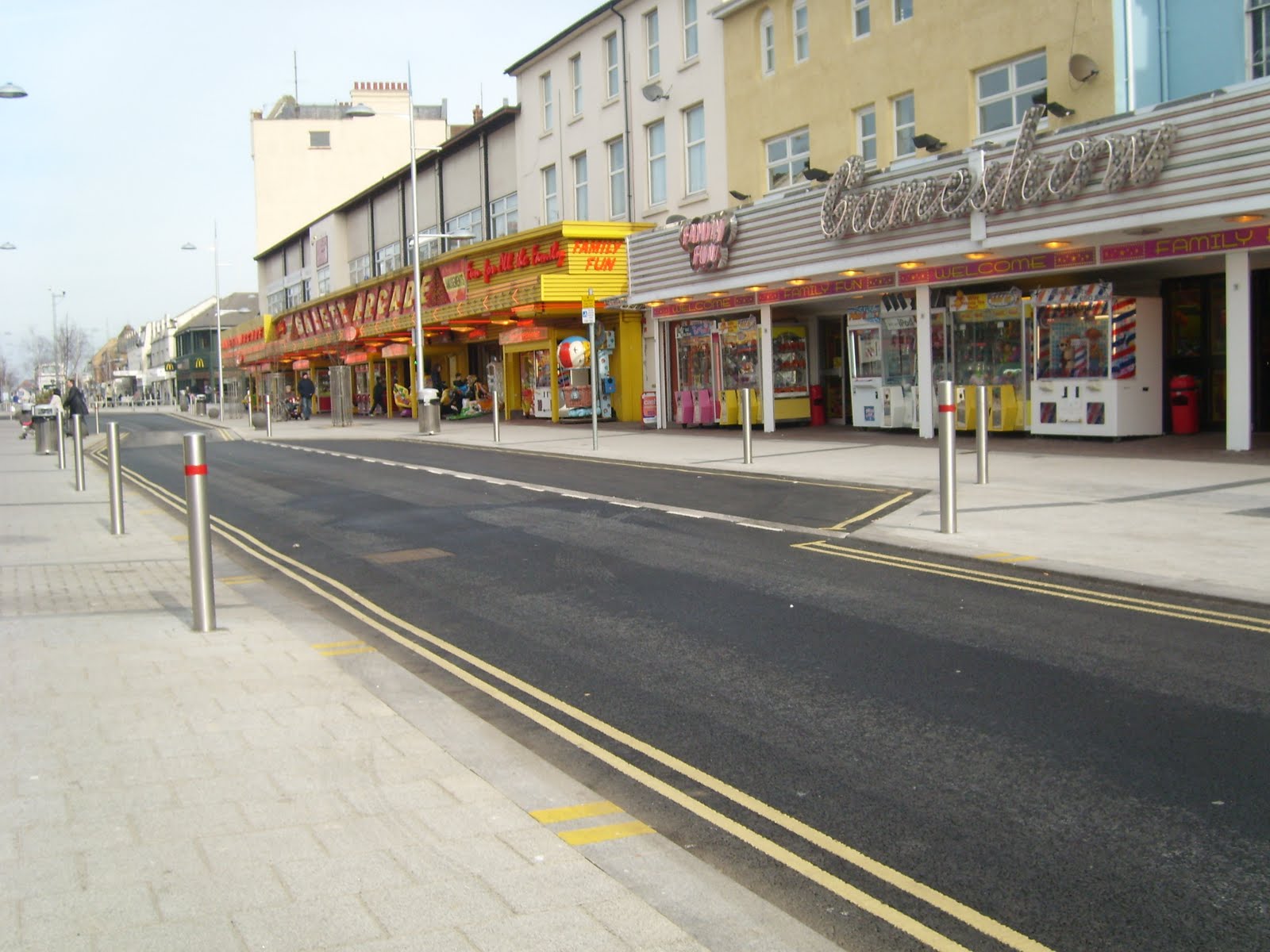
The redevelopment of the seaward stretch of Pier Avenue has at long last been completed. Pavements have been widened and the carriageway narrowed to make it strictly ‘a single carriageway’. It was work that was supposed to have been finished before Christmas but the appalling weather in December put it back, to the consternation of the very traders whom the improvement was supposed to benefit. They complained that they had lost custom because of the long-winded building work and the reduction of access to their businesses that had resulted.

Here is the result. It was a section of Pier Avenue on which the dust had hardly settled since the previous reconstruction that had been carried out with the same purpose! I suppose that it is an improvement but surely, in a time of austerity, it was hardly worth the time, the money, the energy and the disruption that went into it.

The money, and the workmen’s time, would have been better spent seeking out (they’re not hard to find!) and repairing the potholes in Clacton’s roads and the broken, uneven and dangerous pavements away from the town centre. It wouldn’t have been a glamorous or headline-making enterprise but, I think, one of much more real value to we Clactonians.

‘Labour isn’t working!’

Remember that message on a pre-election hoarding long ago? It was illustrated by a dole queue disappearing into the distance. Then, I think, the number of unemployed was more than a million. Nowadays there are two and a half million unemployed, and the number is rising. The Private Sector has failed to absorb the job losses resulting from cuts in the Public Sector. The ‘experts’ were surprised and disappointed. I wasn’t.

It had been obvious to me that, as I have pointed out repeatedly in this blog, there had never been a chance that it would. Successive governments have compelled local and Health Authorities to get rid of their direct labour forces and put their services out to private contractors. One consequence has been that hospitals no longer employ their own cleaners who were known to the other hospital staff and the long-term patients, and who took a real pride in keeping their wards spotlessly clean. They now have to use the employees of contractors, to whom cleaning a hospital ward is ‘just another job’ for which they get as much as they can for as little effort as they can get away with. That’s the way of today’s world.

Another consequence has been to make it impossible to force economies on the public sector without similarly affecting the private. When, for instance, a local authority decides to save money by switching from a weekly refuse collection to a fortnightly one, it is the private firm actually undertaking the collection that suffers. Building maintenance firms, providers of meals-on-wheels, Hospital caterers, cleaners, a wide range of consultants (all part of the Private Sector) and many others, stand to suffer. Their problems may not arrive immediately. Contracts have to run their course. However, come they inevitably will.

I fear that unemployment has not yet peaked.

Prophecies of doom and gloom!

I don’t know how many times I have published my thoughts on the probable course of future events in this blog and have added that I hoped most profoundly that I was wrong. Cassandra probably felt the same way when she predicted the destruction of Troy! She was right, and all too often I have been right too.

I have been proved right in believing that the Private Sector couldn’t possibly find employment for those rendered redundant by Public Service Cuts. It seems that I was right too in my belief that students financing their years of study with government loans would face a lifetime of intolerable debt. It now appears that the better-paid graduates’ careers become, the more likely it is that throughout their working lives (the time in which they are likely to marry, have and bring up children, repay a mortgage on their homes, buy and run a car, and so on) they will be paying off that debt from their undergraduate days. Those who complete the repayment and clear their debt will find that by that time they have repaid twice as much as they originally borrowed!

I have always believed that nuclear energy production is fraught with unacceptable risks. My particular concern was that it had a particularly dangerous waste product that remained lethal for hundreds of years – and for which no-one had so far produced a safe and satisfactory means of disposal. The experience of Three Mile Island, Windscale, Chernobyl – and now Japan, indicates that operating nuclear plant can produce more immediate perils. No-one can tell when and how the present crisis in Japan will end.

Clacton, and the greater part of the Tendring peninsula lie well within the danger zone of Bradwell Nuclear power station, which may well be brought back into
use in the next few years. Sizewell, in Suffolk and just a few miles up the coast, isn’t very far way.

Bradwell is most unlikely to experience either an earthquake or a tsunami, though it should be remembered that the most damaging English earthquake recorded in at least the past 500 years took place in the Colchester area in 1884! Over 1,000 buildings were damaged, in Colchester, Wivenhoe (the epicentre, where every house was damaged!) and other settlements between Colchester and Ipswich.

I think though that Bradwell’s chief danger is its vulnerability to terrorist attack, perhaps as a commando style raid using inflatable craft launched from an apparently harmless fishing boat moored a mile or two out-to-sea.

I very much hope that I am never in a position to say, ‘I told you so!

A Prophecy that failed – or did it?

A week or two ago I said that my best guess about the unfolding crisis in Libya was that the United Nations would ultimately sanction a ‘No-fly’ zone over Libya but that this decision would come too late to prevent the slaughter of scores of innocent men and women when Gaddafi’s troops captured the remaining insurgent strongholds. I was wrong. In the end the Security Council acted swiftly. As, despite the promise of an immediate ceasefire, Gaddafi’s forces launched an attack on Benghazi, French and British planes began bombing military targets and the American navy, using Cruise Missiles has joined in.

I am left with a feeling of profound sadness. It is easy enough to start a war but, as we are finding in Afghanistan, far more difficult to end it. Perhaps this one will be the exception. Perjhaps Gaddafi’s forces will decline to fight a war that they must surely lose in the end, and will oust their leader. Perhaps, but both in August 1914 and in September 1939 there were those who insisted that ‘The war will be over by Christmas!’ When Hitler invaded the USSR in June 1941 he was sure that a few victorious battles would swiftly bring about the collapse of the Soviet regime.

As with the blitz in England, air attacks are just as likely to unite the country in anger and thirst for retaliation as to induce despair. Western intervention will inevitably bring accusations, however unjustified, that this is another ‘crusade’ aimed at destroying Islam. Like the wars in Iraq and Afghanistan it will bring joy to the hearts of those who are grooming young Muslims for recruitment into terrorist organisations. The probability of terrorist attacks in Europe and the USA will increase.

A war in the Libyan Desert will inevitably bring a very serious risk of casualties from ‘friendly fire’ among both civilians and combatants. Both sides discovered that in the war in which I was engaged in 1941/’42. There were no defined front lines and a surprise attack could come from any direction. Both sides were making use of captured vehicles, and the desert uniforms of the opposing armies were not readily distinguishable. On many occasions army vehicles, lost in the desert (in a dust storm perhaps) would spot an army convoy that they fondly imagined was ‘one of ours’ and discover too late it was, in fact, one of the enemy’s. This encourages nervous soldiers to ‘fire first and identify the bodies later!’ In the present conflict all military vehicles and heavy weapons used by the insurgents will have been captured from the Libyan Army.

One such friendly fire incident has already occurred. On the very day that the Security Council made its fateful decision, the defenders of Benghazi were jubilant at having shot down in flames a Libyan Air Force plane. Sadly it was, in fact, a plane whose pilot had defected to the insurgency.

The support of western intervention by the Arab League is said to have been an important factor in the Security Council’s decision. It has certainly landed us with some very strange allies in the struggle against Gaddafi! Members of the Arab League include Bahrain, whose ruler has brought in foreign troops to brutalise the peaceful but determined majority who oppose his rule. These foreign troops came from Saudi Arabia, a leading member of the League and a land where the practice of religion other than Islam is strictly prohibited, public floggings and beheadings are part of the criminal law, and women are treated in a way that we in the west would regard as intolerable. Then there is Yemen where we have learned that pro-government snipers have shot and killed a number of peaceful protesters congregating after Friday prayers in a public square.

Those countries are certainly not the first that come to mind as enthusiastic supporters of a campaign to bring freedom and democracy to the benighted land of Libya! They do, of course, have one thing in common. Their autocratic rulers have remained in power for as long as they have with the generous support of Britain and the USA.

I hope and pray, though without a great deal of conviction, that this conflict will swiftly end, and that Libya, together with newly self-liberated Egypt and Tunisia, will prove that Arab and Islamic states can develop into liberal and tolerant democracies.