Showing posts with label Fracking. Show all posts

26 April 2015

26th April 2015

Tendring Topics………on line

Humankind’s Priorities

          The appalling earthquake in Nepal reminds us of the potential destructive power of nature.  In a few minutes thousands of human lives were lost and hundreds of buildings flattened.  The power of the quake shook houses and caused panic in Calcutta hundreds of miles away.  It also shook Everest the world’s highest mountain causing avalanches that cost yet more human lives.

            In Western Europe, including the United Kingdom, we may feel free of danger from earthquakes but the warnings of the world’s scientists about the effects of global warming are becoming more and more urgent.  Instead of recognising that climate change is largely the result of mankind’s misuse of the bounties of nature we blindly continue draining existent oilfields and finding new ones. Now ‘market forces’ demand that we. turn ‘England’s green and pleasant land’ into an industrial wilderness by fracking for oil and gas in subterranean beds of shale.   We have been warned that governments should take immediate action to seek out and develop sustainable and non-polluting sources of energy – the use of wind, sun, the waves and the tides – and phase out the use of fossil fuels.  The evidence of the effects of global warming are all around us -  unprecedented typhoons and hurricanes, floods, bush fires, droughts and periods of unseasonal extreme weather conditions.  The arctic ice is thawing every year, the glaciers are retreating and the world is facing climatic catastrophe.  The general election is now less than a fortnight away.   No-one would have guessed from the televised debates between the political party leaders that our country (and the world) is threatened by the inexorable and accelerating progress of climatic change.  Most are much too busy scoring political points against their political opponents, and earning the votes of the gullible, by making impossible promises that will turn out to be no more than aspirations.  David Cameron, Ed Miliband and Nick Clegg all accept the reality of global warming and its consequences – but all are prepared to ignore the warnings, at least until after the election, because ‘there are no votes to be obtained by banging on about climate change’.

            Nigel Farage is at least honest in his intentions.  Denying the warnings of the world’s scientists, he doesn’t believe in the reality of global warming or – if it is taking place – that it is anything to do with human activity.  He’d drag the last barrel of oil and cubic foot of gas out of existing wells and encourage the frackers. He’d withdraw financial support from wind and solar farms. 

            The only party leader who has tried to highlight the real and urgent problems arising from an over-exploited natural world is Natalie Bennett, Leader of the Green Party.   Below you’ll see a copy of an email that I have received from her that sets out her, and the Green Party’s priorities.  If you believe that The Greens are fighting for a cause in which you believe, don’t be persuaded that ‘a vote for the Greens is a vote wasted’    If everyone had said that about the fledgling Labour Party at the beginning of the 20th century, Labour would not now be competing with the Conservatives for power.      ‘This above all, to thine own self be true’. 

Hello Ernest,

This year the most important climate talks in history will take place in Paris.

Leaders from around the world will come together to decide the world’s course of action in addressing the most important issue of modern times.

Yet, despite the looming threat of a climate crisis, during this election you could be forgiven for thinking that the threat had lifted.

The truth is, politicians from the other parties simply aren’t speaking about climate change. In fact I was the only party leader to raise the topic during the three and a half hours of Leaders debates.

You and I know both know that the science is unequivocal – fortunately we have the plan to tackle the crisis.

The Green Party is the only party calling for the urgent action required and at the heart of our pledge to protect the environment is our conviction that we must also reconfigure our world to work better for people.

We will cut public transport fares – because everyone should be able to afford to get to where they want to go – and because the air pollution caused by cars is a crisis that must be tackled.

We will invest in home insulation – because no one should fear family members getting ill or even dying from the cold – and because we want to cut carbon emissions.

We will generate 80% of our energy from renewable sources by 2030 – because we know we must leave four-fifths of known fossil fuel reserves in the ground.

We are using three times as many resources as our planet can sustain - we must change course, and we can.

I, like you, want to leave a better future for our children. I want the next generation to look back on what we did at this time and think  ‘my parents’ generation did something to protect our world’. I want them to be proud of us.

To keep climate change on the agenda and to continue our fight for social justice we must elect more Green MPs.

We can do this if we have a strong Green voice in parliament - but we need your help now more than ever with a Green vote on May 7th.

Thank you,

Natalie Bennett
Leader, Green Party of England and Wales

           
Well, I’m a postal voter and have already posted off my vote for Chris Howell, Clacton’s Green Party Candidate.  I hope that at least some regular readers of this blog will also vote Green!


                                          Ernest Hall


13 December 2014

13th December 2014

Tendring Topics…….on line

The World’s most polluted spot!

          A few weeks ago I quoted, at some length, my elder son’s concerns about air pollution, particularly in London.  Now air pollution – from motor vehicles – has become a matter of national concern. Even towns in our largely agricultural East Anglian Region are seriously affected.  It has, so it is reported, become almost as serious a killer as tobacco smoking.   Last year in the UK air pollution was responsible for nearly 20,000 preventable deaths.  In some towns pedestrians are being advised to walk along the footpaths as far as possible away from the carriageway, not because of the danger of being struck by a vehicle mounting the pavement – but because a distance of even a few feet further away from the vehicle exhausts can reduce the risk of lung damage.

            Where, do you think, is the most polluted air in the whole world?  My guess would have been somewhere in Beijing – or possibly in Rio de Janeiro or Chicago.   I’d have been wrong.  It is, in fact, London’s Oxford Street – the home of Harrods and of other quality retailers where the seriously rich do their shopping.  In Oxford Street the high-rise (by British standards) buildings create an artificial canyon to retain the polluted air while continual starting and stopping of the diesel engines of buses and taxis inexorably add to the pollution.  

            The first reaction of Mayor Boris Johnson was to question the findings of the scientists who had revealed that Oxford Street’s air was the most polluted on earth.  He now accepts the report’s validity – but hasn’t so far done anything about it.   Sadly, it’s one of those issues like climate change.  Hardly anyone now doubts that climate change is taking place, and scientific evidence overwhelmingly indicates that it is largely a result of human activity - but to take effective action would cost money, and possibly lose votes!  So would taking effective action against vehicular air pollution.

            In our free market society where everything and almost everybody has a price, short-term profit will always triumph over long-term benefit.   So polluting motor vehicles will not be banned from city centres in the near (or middle-distant) future, and we’ll carry on – and speed up - fracking!

The Consequences

          On Monday 8th December the local Daily Gazette had the front-page headline We’ve got to build 21,000 homes by 2032.  The headline didn’t relate to the Gazette’s complete circulation area but simply to the borough of Colchester.  The adjacent authority of Tendring District – comprising the coastal towns of Clacton-on-Sea (where I live) Brightlingsea, Walton-on-the-Naze, Frinton-on-Sea, Dovercourt and Harwich and the rural hinterland of the Tendring Peninsula, has a similarly ambitious building programme with one substantial housing estate to be built immediately adjacent to the boundary with Colchester.

            Wonderful news for those of the homeless who are willing and able to buy their own homes.  I suspect though that very few of those dwellings will be ‘social housing’ – owned by the local authority or a Housing Association and available for letting at a reasonable rent.   Good news too for workers in the building industry who will have the promise of work for nearly two decades – and I have little doubt that the major supermarket chains will increase their stake in the area, providing new branch retail outlets to meet almost every need of the new home buyers and their families.

            But it will only be almost every need.  We have so far heard nothing of the provision of other essential services that do not yield an early profit for the provider, such as education and the Health Service.   21,000 new homes in Colchester and a similar number in the Tending district suggest that there may be as many as 30,000 extra children all needing education in the next decade and a half.  Are there any plans to build new schools for them?

            As for the health services in the Clacton/Colchester area; the currently available services are already proving woefully inadequate for the existing population.  They are quite incapable of dealing with perhaps an influx of perhaps 60,000 new residents.  Colchester General Hospital is under ‘special measures’.  Appointments for diagnostic examination of serious medical conditions are postponed and then delayed indefinitely because of a failure of the medical staff to be present when promised and of the administrative staff to find a locum.  Less medically serious but affecting a great many patients and their friends and relatives, is the inadequacy of the car parking facilities at the Colchester General, whether for keeping appointments at out-patient clinics or for visiting in-patients.  This has been made worse by the transfer of services from the Essex County Hospital which is to be demolished and the site used for bungalow building (more potential patients!) in the future.

            In the ‘front line’ of our health services are the many medical practices throughout the district.  It seems that the situation is much more serious in Clacton, Frinton and Walton than it is in Colchester.   I have been with the same medical practice in Clacton since my family and I moved here in 1956.  There were then two doctors (both Scots and astonishingly similar to the Dr Finlay and Dr Cameron of tv’s Dr. Finlay’s Casebook!).  Since those days the practice has doubled the size of its premises and had many changes of doctors. I have been very pleased and happy with the service that my family and I have received from them.  They have seen my two sons through their childhood illnesses.  They cared for my wife who had recurring ill-health.  I particularly appreciated the doctor who called every day as my wife’s life was ending, and (against the advice of the district nurse) supported my determination to keep her at home and to care for her to the end.   They have patiently and professionally looked after me through the health problems of old age.  

However I have seen the number of doctors grow from two to, at one time, six and then decline to the three that it is today.  I am quite sure that if I had a serious medical condition one of those three doctors would see me without delay but it is becoming increasingly difficult to get an appointment with the doctor of my choice. They badly need at least one more – preferably two more – doctors.  They are obviously quite incapable of dealing with an added influx of patients. It’ll be wonderful for there to be a home for everyone who needs one – but I hope that some thought has been given to the inevitable consequences.

The Ukraine

            The conflict in eastern Ukraine isn’t the bloodiest or the most devastating war in today’s sad world (though it has the potential of developing into World War III, if the world’s political leaders are even stupider than I think they are), but it is of particular interest and concern to me.  That’s because it is possible that  some of those on both  sides of the conflict, could be the grandchildren of the friendly ‘Ostarbeiters’ (men and women from Russia and the Ukraine) who, as 'forced labourers' were often my fellow workers when I was a prisoner of war at a small working camp in Germany from 1943 till 1945.  We shared our labours and we shared our work-breaks. Often, in broken non-grammatical German, we shared parts of our life-stories too.  We were all good friends and good comrades against our Nazi bosses.

            An uneasy cease-fire currently exists over eastern Ukraine but my interest was revived when I heard a tv commentator remark that the ill-fated Malaysian air liner, shot down with the death of all its crew and passengers, had been a victim of the ‘cross-fire’ between the warring factions. ‘Crossfire’?   It was surely flying several thousand feet above that!  The black boxes, examined by international experts revealed that  the plane had been shot down by a surface-to-air missile but that there was no way of telling which side had fired that missile.  One thing is quite certain.  Neither side deliberately shot down a Malaysian passenger air-liner.  Whoever did so had wrongly imagined they were targeting a high level enemy bomber.

            Most people in ‘the west’ probably believe that the eastern rebels (aided and encouraged by Russia) were responsible.  One snag about that idea is that the rebels possessed no ground-to-air missiles or the means of projecting them to their targets.   There were unconfirmed reports from the Kiev government that a Russian missile launcher had been seen passing surreptitiously into Ukraine. However, the American CIA found no evidence that Russia had been involved in the plane’s destruction. Had there been any such evidence I have little doubt that the CIA, with very few scruples and spies in every country, would have found it!

 The rebels are also said to have delayed the United Nations inspectors in their examination of the wreckage, mostly in rebel-held territory.  The fact is that the rebels didn’t delay the UN inspectors – it was the Kiev government’s continued shelling of the search area that did that.  The rebels found and handed the plane’s ‘black boxes’ over to the UN authorities (they could easily have ‘lost them’ had they thought they might establish their guilt).  Immediately the ‘black boxes’ had been despatched to Britain for opening and examination, a spokesman for the Kiev Government announced that they had established the rebels’ guilt.  At that stage they hadn’t even been opened!  It is clear that the Kiev Government was desperately eager to persuade the world that the rebels were guilty.    

            Suppose though that that  government, knowing that the rebels had no air force of their own to respond to their  continual air attacks, had expected them to seek Russian help.  They may well have possessed ground-to-air missiles, the means of firing them, and the skill needed to do so  As a ‘sovereign state’ they could purchase any weapons that they chose to, and train their soldiers to use them.  Those in charge of their air defences might well have been ordered to look out for high-flying Russian bomber aircraft – and have been told that any large unidentified aircraft flying in Ukrainian air space was likely to be Russian.  So – it is surely at least as likely that it was Kiev Government forces as the the pro-Russian rebels, who brought down that Malaysian air liner, believing it to be a Russian bomber. Their eagerness to blame the rebels with little or no evidence, adds credence to this idea.

              Most responsibility though for that tragic accident must surely be borne by those in Malaysia who had routed a vulnerable passenger air liner directly over a conflict zone.  Only a month or two earlier another Malaysian air-liner had been lost without a trace – and still nothing has been discovered about the cause of that air liner’s disappearance.   Nor do we know, even approximately, where the disappearance took place.  I don’t think that Malaysian Airlines would be my first choice were I to be considering long-distance air travel!  

            For the sake of Ukraine, of Russia, and of the whole world, I hope and pray that those who may be the grandchildren of my friends from long ago, will come to an agreement acceptable by both sides, stop killing each-other, and co-operate to maintain the peace and increase the prosperity of the whole region.  I wish them all a very Happy Christmas and a New Year of Peace and Hope. 


21 January 2014

Week 4 2014

Tendring Topics……..on line

The Prime Minister’s Choice

          In last week’s blog I said that the Prime Minister’s reaction to the increasingly clear evidence of global catastrophe resulting from accelerating world-wide climate change would tell us whether he really was a far-sighted statesman determined to pull his country, and lead the world, back from the abyss – or whether he is just another  politician whose vision doesn’t extend beyond the next general election..

            I fully expected to have to wait a few weeks for the answer – but it was made clear even before my blog had been posted on the internet!   No – the Prime Minister isn’t going to redouble efforts to reduce our national dependence on the fossil fuels that are producing catastrophic weather conditions across the globe, and to set an example to other industrialised nations to do the same.  On the contrary, he is proposing to bribe local authorities into permitting ‘fracking’ in their areas, and is telling us that these operations will result in the creation of thousands of jobs, cheaper gas and oil and less dependence on our  obtaining these fuels from the world’s political  trouble spots.

            Those local authorities that accept the bribe won’t have to cut their budgets as severely as they had expected and we can, so the Prime Minister claims, all hope for less expensive fuel and a marked further reduction in the number of unemployed.   That should be worth a few thousand votes in the next election.  When Mr Cameron decided to opt for the political alternative he certainly did so in style!

            Will fracking threaten our water supplies and produce the mini-earthquakes that its opponents prophecy?  Possibly not, if the operators carefully follow every recommended safety precaution.  However  since the products of successful fracking are fossil fuels, one thing that their use certainly will do is increase the greenhouse gases in the atmosphere and thus accelerate even further the climatic change that is threatening us all.

            A feature of the fracking operation about which I heard for the first time on the tv news this (13th January) evening is that profitable production from a ‘fracking well’ lasts only four years.   It then becomes necessary to sink another well elsewhere.  That no doubt accounts for the fact that I have seen aerial photographs of considerable areas of the USA reduced to an industrial desert by fracking operations.  That – as well as the possibility of cheap fuel, a reduction in the unemployment figures, and increasingly extreme weather – is something to which we can look forward in ‘England’s green and pleasant land’.   That’s the kind of prospect that makes me feel quite glad that my ninety-third birthday approaches!

Gove’s War

          I have to confess that Michael Gove is one member of the government for whom I have, on occasion, felt just a little sympathy.  I think, as he evidently does, that there is something wrong with our educational system and it seems to me that some of his ideas, although they are greeted with derision by most of the teaching profession, have merit in them. 

            However I have often been glad that Mr Gove is not concerned with foreign affairs or with the armed forces.   He must surely be one of the few people in the UK/in Europe/in the world, who can look at the Middle East and still believe that the invasion of Iraq (for which the infamous Bush/Blair axis secured parliamentary approval only by deception) was a ‘good thing’ and has resulted in a better and more peaceful world.   Tell that to any member of Iraq’s Christian community. They were tolerated and influential in Saddam Hussein’s time, but now, like most Christians in Muslim-majority countries, they are living constantly under threat and seeking refuge elsewhere when they can.  Tell that too, to Shia Muslims living in Sunni areas and vice versa.  El Qaida, which prior to our ill-conceived and illegal invasion, scarcely had a foothold in Iraq, now flourishes!

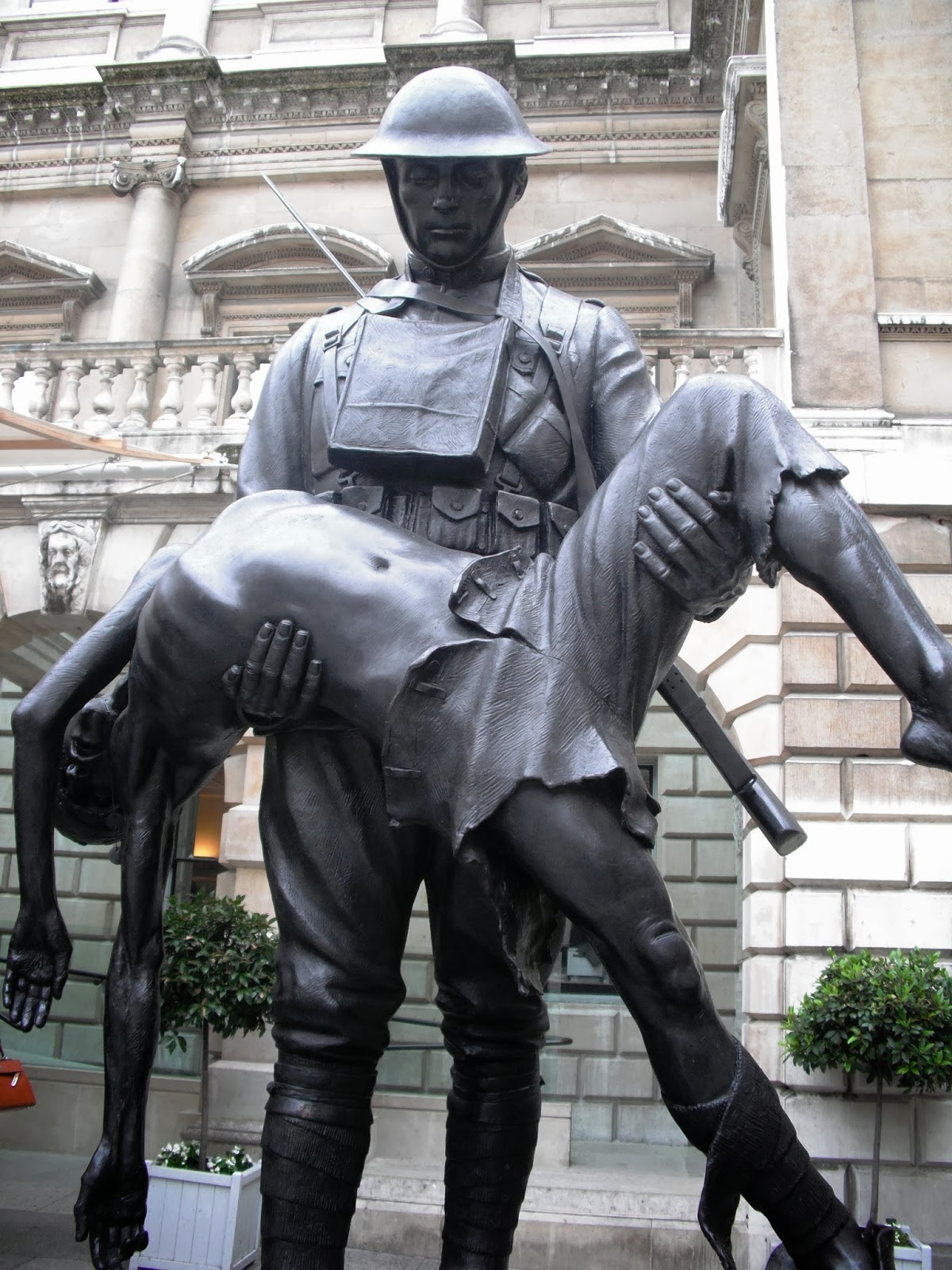
This war memorial, to the fallen of the American ‘Rainbow Division’ catches something of the pathos and tragedy of World War I    

Now, during the centenary year of the outbreak of World War I, Michael Gove urges us to ‘celebrate’ what used to be called ‘the Great War’ and to ignore the ‘left wing intellectuals’ who claim that it was a flagrant and appalling squandering of human life engineered by scheming politicians and made worse by incompetent military commanders driving (but never leading!) masses of unwilling soldiery like sheep to the slaughter.  One doesn’t have to be left-wing or particularly intellectual to accept the remembered testimony of those, now no longer with us, who fought in and survived that war – and the evidence of the World War I cemeteries and war memorials in northern France  and Flanders.

            Probably the most famous war memorial in mainland Europe is the Menin Gate outside Ypres, the only Belgian town that was never under German control during World War I, where some of the bloodiest battles of that war were fought.  Completed in 1927 the Memorial was intended to bear the names of the British and Commonwealth soldiers who were known to have been killed in those battles but whose bodies had  never been found. There were 55,000 such soldiers and, huge as the Menin Gate memorial is, there was found to be insufficient space for 55,000 names. Consequently the Menin Gate has the names of only some 35,000 names and the others are memorialised elsewhere!

            Poet, author and war hero Siegfried Sassoon* (he was awarded the M.C. Military Cross* for his conspicuous gallantry) wrote of the Menin Gate,

Well may the dead, who struggled in the slime,
Rise and deride this sepulchre of crime.

            I reckon that if Siegfried Sassoon were alive today he would say much the same about the  ‘celebration’ of the centenary of the outbreak of World War I.  I and other ex-servicemen survived World War II because military commanders in that war were less careless of human life than their predecessors had been just over two decades earlier.
           
I hope that we will remember the outbreak of World War I with repentance for human folly and wickedness and determination never again to be deceived by scheming politicians into the wholesale slaughter of our fellow men and women. As for Michael Gove – a Biggles Omnibus and a few ancient copies of The Boys own Paper should keep him happy.   Let us hope that he is never in a position to realize his dreams of military glory.

            *Siegfried Sassoon was a volunteer infantry officer who became aware of the criminal waste of human life in World War I and subsequently became a peace campaigner.  His paternal ancestors had been Iraqi Jews and he owed his German Christian name to his gentile mother’s love of Wagner’s music. He was undoubtedly recklessly courageous and was known as ‘Mad Jack’ as a result.  It has been said that OBE sometimes stands for ‘Other B………. Efforts’.  No-one has ever been awarded an M.C. for any efforts other than his or her own.
           
Calling all (or any!) local blog readers

            Such are the wonders of modern technology that I can be pretty confident that there are over 2,000 regular readers of this blog world-wide.  I know that I have many readers in the USA and in Russia as well as in the UK, readers in Germany, Poland, Bosnia and the Ukraine and even a few in India, in mainland China and Vietnam. What I don’t know is whether I have many local readers, from southern East Anglia – in particular from north-east Essex and southern Suffolk.

            I know that I have one or two because they have contacted me – but perhaps that’s the lot.  We have it on the very best of authority that a prophet it less likely to be honoured in his own neighbourhood and among his own people than further afield!  This particular item is especially for all – or any – local blog readers.

            On Sunday 12th January, BBC tv’s Countryfile programme invited viewers to contact them if they felt that a Countryfile programme might possibly be made in their particular area.  These programmes cover local farming but also most other rural activities and interests – particularly where there is local controversy,  such as the tourist development of Dedham Vale for instance.

Bridge Cottage, Flatford Mill         

I have emailed them suggesting the Suffolk/Essex border area; the countryside that inspired Constable and Gainsborough, from Sudbury through Dedham, Flatford Mill and Manningtree to historic Harwich, home of the Mayflower.  Then there’s the rich agricultural land of the almost-an-island Tendring Peninsula, with Walton Backwaters – scene of one of Arthur Ransome’s children’s novels and, on the outskirts, Colchester, England’s oldest recorded town as well as, on the Essex 'sunshine coast', no less than five coastal holiday resorts, each with its own character but all having safe, clean, sandy beaches, ‘all the fun of the fair’ for those who want it and the lowest average annual rainfall in the British Isles;  all easily accessible from London!

                                   The home of the Master of the Mayflower in Harwich        

  I am quite sure that a visit from the Countryfile team and a programme featuring the Essex/Suffolk border would enhance the economy of the whole area and bring us welcome holiday visitors.  Why not respond to the Countryfile appeal and suggest a visit to our region?  Emails should go to countryfile@bbc.co.uk   If you have any photographs of the area send them as attachments.   To my own email I attached a photo of Bridge Cottage, Flatford Mill, and one of the Harwich home of the Master of the Mayflower. Here they are!


20 August 2013

Week 34 2013

Tendring Topics……..on Line

Fracking

A’fracking we will go,
 A’fracking we will go,
Because our toil
Will find the oil
That makes the economy grow, grow, grow!
That makes the economy grow!

The above ditty, which I offer free of copyright to anyone who wants it, could well become a popular playground song of the 2020s though only, of course, if a strictly non-profit-making activity like singing is permitted by the Directors of the Education Industry (by then fully privatised and market sensitive) during primary schools’ productive leisure periods, formerly known as ‘playtimes’.

‘Fracking’ is by no means the most attractive and melodious word to have been introduced into the English vocabulary by modern technology – but it seems likely to be one to which we will have to accustom ourselves.  It is a shortened form of ‘hydraulic fracturing’, a means of extracting gas and/or oil from hitherto inaccessible, but apparently plentiful, reserves of both these sources of energy in beds of shale deep below the earth’s surface.

Like the coal, gas and oil to which we are accustomed they are ‘fossil fuels’ and thus doomed eventually to come to an end.  However they will – if exploited - reduce our current dependency on oil and gas from distant and unreliable overseas sources.  They will also postpone, perhaps for many decades, the exhaustion of these sources of energy and their inevitable increase in price as they become depleted.   What a relief to politicians – no need to persevere with those unpopular wind and solar energy farms!   No expensive and unpopular barrages to be built across the Severn and other estuaries to harvest tidal power!  That’ll really confound the ‘green lobby’, and trim the wings of UKIP and other organised opponents of green energy!  A government that welcomed fracking (thousands of jobs, smaller fuel bills, cheaper petrol – perhaps) should surely gain thousands of votes. Any serious troubles that may arise from it are probably several general elections away!

There will be trouble of course.  The process of fracking, if I have understood it correctly (and if I haven’t I’ll gladly publish any corrections that blog readers send me!) is to bore vertically a mile or more down from the earth’s surface, lining the borehole with concrete to prevent seepage of pollutants into the subsoil; then, when a pre-determined depth has been reached, extending the bore-hole horizontally for perhaps another mile underground. The ideal situation, I understand, is for the horizontal excavation to be through porous sandstone between two strata of shale.

Now the work that gives the operation its name begins.  Water, charged with grit particles, is forced under very high pressure into that horizontal bore-hole.   The pressure fractures the shale beds (the actual ‘fracking’) and grit carried by the pressurised water prevents the tiny fractures from closing again.   The water is then pumped out and oil and/or gas that had been held within the shale leeks into the bore-hole from those fractures.   The borehole becomes a well.

As I typed those last two paragraphs the sequence of events seemed to become more and more improbable with every word I typed!   However, fracking has been carried out with success for many years in all parts of the USA and has been proved to be successful in this country too.  There are snags about it.  The actual fracking is done deep underground but the surface works are extensive and, to say the least, unsightly.  Pictures have been shown on our tv of no-doubt formerly attractive countryside in the USA turned into desolate – but highly profitable - wasteland.  The fracking operation has been known to cause earthquakes – only small ones perhaps but earthquakes none the less! As well as the despoliation of the environment, fracking brings very real dangers of pollution of lakes and rivers and, in particular perhaps, of aquifers or natural underground water reservoirs.

Unsurprisingly, like sewage treatment works, landfill refuse disposal sites and waste incinerators, no-one wants a Fracking operation anywhere near their home.  They are the ultimate NIMBY (not in my back yard!)

Lord Howell, Mrs Thatcher’s Environment Minister and George Osborne’s father-in-law (a weighty thinker if there ever was one!) recently gave members of the House of Lords his valuable thoughts about the future location of Fracking wells:

‘But there are large and uninhabited and desolate areas. Certainly in part of the North East where there’s plenty of room for fracking, well away from anybody’s residence where we could conduct without any kind of threat to the rural environment.’
            Geordieland is certainly ‘well away’ from Westminster and from  London’s ‘stockbroker belt’ but I doubt if the residents of Newcastle-on-Tyne,  Durham and other North-eastern  cities would agree that their beautiful  unspoilt countryside and coastline were ‘desolate areas’ offering ‘plenty of room for fracking without any kind of threat to the rural environment.’’
As it happens it seems that beds of shale offering rich pickings to frackers are distributed pretty evenly over – or rather under - ‘England’s Green and Pleasant Land’  There are areas of southern England where the residences of  some of the government’s most loyal (and wealthy and generous!) supporters are to be found, that are particularly promising.  Wouldn’t it be wonderful if our Prime Minister demonstrated his enthusiasm for this exciting new wealth-creating enterprise by encouraging one or two trial holes to be bored in Buckinghamshire (not a heavily populated county) in the immediate vicinity of Chequers!
I think fracking is a very interesting idea that may well have a great future – but I’m quite glad that no geological map of England I have seen shows any sign of oil-or-gas bearing shale strata beneath the fertile fields, wind-swept heathland, winding estuaries and salt marshes of East Anglia!
…….as others see us!
 
Ray and Ingrid
          
 I had a very pleasant surprise on Sunday 12th August.  Ingrid my German friend of many years standing, and her English partner Ray had been entertaining two sixteen year old German girls from the Bayreuth area of Bavaria who were for the first time paying a short visit to England.  The previous day they had taken them on a lightning tour of London, seeing Trafalgar Square, Buckingham Palace, the House of Commons, London Bridge and Tower Bridge, the London Eye and Oxford Street.
            Sunday was their day to see the English seaside.  Where better than Clacton-on-Sea with which Ray was familiar (his home is in Ipswich) and Ingrid has visited on two or three previous occasions.  They spent the morning and the early part of the afternoon on the pier and the beach and called on me, for a cup of tea and a chat, at about 4.30.
            I found the two visitors to be very courteous and friendly young ladies who were full of teenage enthusiasm for England and everything English.  They had thoroughly enjoyed their visit to London, where they had seen all the places they had heard about or seen on German tv.  I was astonished that they commented on the cleanliness of London’s streets – though it is some years since I have been to the capital and over sixty since I lived there. Perhaps things have changed since those days.
            They were no less enthusiastic about Clacton.  I am glad they saw us at our best.  It was a warm and sunny day at the beginning of carnival week.   They had thoroughly enjoyed themselves on the pier and on Clacton’s safe and sandy beaches – though of the four of them, only Ingrid had had a swim.  The others found the North Sea too chilly, even on a warm and sunny day in August.  They had been somewhat disconcerted by the speed of the rising tide!  The girls had previously known only lake-side beaches and Ingrid had spent only a brief time on a beach on her previous visits to Clacton
The two girls were learning English at school and our conversation took place in both English and German.  Either I said very little (which those who know me best will consider unlikely!) or my German is much better than I had thought it was, because Ingrid emailed me later to say that one of the girls had subsequently asked her if I was German or English!  Be that as it may, it is good to know that two German teenagers have returned from their first visit to England with wholly positive thoughts about our country and about Clacton-on-Sea and the Essex Sunshine Coast.


.