Showing posts with label Michael Gove. Show all posts

10 February 2014

Week 7 2014


Tendring Topics…..on Line

 
Mr Gove in the News

 
             Michael Gove, the Government’s Education Secretary, has been in the news lately.  First of all there was his naïve demand that we should celebrate the centenary of the outbreak of World War I and ignore the left-wing intellectuals who insisted that it was a gigantic waste of human life from which no-one really emerged victorious except the armaments manufacturers. Born in 1921, I am not old enough to remember the war. I can though, remember being taken as a very young child to Remembrance Day (we used. to call it Armistice Day) services where there were still tearful  women clad in black mourning dead sons or husbands, and still-young ex-service men with missing arms or legs, or unsteadily making their way with the aid of a white walking stick.  There was not much celebrating then.
 
                    Then there was Mr Gove’s decision not to renew the contract of the Labour- supporting Chairman of Ofsted in order, so it was claimed, to replace her with a Conservative supporter – perhaps a generous donor to the Party. Needless to say Mr Gove indignantly denies any such motive.  It was, he said, a good idea to get new blood into any public office after three years (he clearly didn’t include the post of Education Secretary that he has held for four years!) and claimed that he always selected the best person for the job, irrespective of political affiliation.  Well, naturally – but the best person for the job in Mr Gove’s eyes would obviously be someone who would pursue his sometimes revolutionary ideas with genuine enthusiasm.

 
             I remember, in the turmoil of local government reorganisation in 1973, applying for the post of Director of Housing with the Harlow District Council.  I was asked if I would have any problem working with a Labour Council when my previous experience had been only with Conservative authorities. I replied that I believed senior local government officers, like civil servants, should be prepared to serve loyally authorities of any political persuasion.   Perhaps if I had replied that I was a whole-hearted Labour supporter and had for years been yearning for service with an unequivocally Labour Council (which, at that time, wouldn’t have been far from the truth) I’d have got the job!  Never mind – I was appointed as Public Relations Officer to the Conservative Tendring District Council, and I did put everything of which I was capable into it.   It was much less well paid but more congenial – and it didn’t involve my wife and I moving from our home in Clacton-on-Sea.

 
                 Mr Gove’s latest crusade is to make state schools as good as those in the private sector by lengthening the school ‘working day’ and encouraging extra-curricular activities like music and art appreciation, membership of the Army Cadet Corps and so on.  I think perhaps by ‘private schools’ he meant ‘private boarding schools’ where the children are available for education, or perhaps for indoctrination, for twenty-four hours a day.

 
                     When I was at a state secondary school in the 1930s, our school hours were from 9.00 am to 4.30 pm Mondays to Fridays and, once we had progressed beyond the 1st Form, from 9.00 am till 12.00 noon on Saturdays.  We did though have two hours 12.00 till 2.00 pm for lunch (or as we young ‘plebs’ called it, ‘dinner’) and I cycled home every day because I preferred my mum’s cooking!   Added to that we were expected to do one hour’s homework every evening when we were in the first form, one and a half hours in the second and third forms and two hours in the fourth and fifth forms as we prepared for the General Schools’ Leaving Exam (the Matric).  There really wasn’t a lot of spare time for playing at being soldiers or whatever! 
 
I have no doubt that private boarding schools do teach children to speak properly, to be well mannered and self confident, and to have at least a smattering of knowledge of art, music and literature.   I have often wished that I had had those qualities when I left school, but I have sometimes been astonished at gaps that there appear to have been in the education of some of their best-known former pupils.

                   David Cameron our Prime Minister for instance, attended one of the very poshest of posh public (which actually means ‘private’) schools.  Yet he imagined, until someone corrected him, that the United Kingdom had been the ‘junior partner’ to the USA in the struggle against Hitler and Nazism in 1940.  Subsequently it transpired that he was unfamiliar with the third verse (few people nowadays even realize that there was once a second verse!) of our National Anthem.

 
             I suppose those are the kind of gaps that one might expect to find in the knowledge of the average bank or insurance clerk, shop assistant or postman of Mr Cameron’s age.  Surely though our Prime Minister (in fact all our leading politicians) should be thoroughly familiar with the history of the past century, if only to avoid making some of the mistakes that were made at that time.  It might have been thought too that the leader of a Party that aspires to ‘making Britain Great again’, is proud of its patriotism, and has appropriated the Union Jack for its political meetings, would have been familiar with:

 
Thy choicest gifts in store
On her be pleased to pour.
Long may she reign!
May she defend our laws
And ever give us cause
To sing with heart and voice
God Save the Queen.

 
               Yes, I did type the above verse from memory – but must confess that I later checked with Google that I’d remembered it correctly!

 
Mixed News from Clacton-on-Sea

             Recently, whenever Clacton-on-Sea has been featured in the national news bulletins or the front pages of the national press, it has been with bad news.
 
             We’ve an enormous bed-sit population living on ‘benefit’. Jaywick, one of Clacton’s suburbs is officially the most deprived community in the UK.  While the crime rate over the rest of the country and, in fact, over the county of Essex, is declining, in Clacton-on-Sea it’s rising.  There’s never a mention of the the fact that visitors to our town are rarely aware of any of those things, that we have suffered very little from the floods and gales that have afflicted the rest of the country since the beginning of December, that we have safe, sandy beaches, a lively pleasure pier and the lowest average annual rainfall of any seaside holiday resort in the British Isles!

 
              Once again disaster has struck Clacton and has made the national headlines – but this horror story isn’t all bad.  Last Wednesday (5th February) what is believed to have been an accidental gas explosion completely destroyed two semi-detached houses and damaged others in the vicinity.  Two people were seriously injured and were air lifted by helicopter to a hospital in Chelmsford for treatment, and eleven others, less seriously injured, were taken by road ambulance to Colchester General Hospital. Considering the extent of the damage it is surprising that there were no fatal casualties on the spot.  Had the explosion occurred just half an hour later than it did, it might well have involved young children on their way to the nearby St. Clare’s Roman Catholic Junior School.

              The positive side to this sad story?   It was the Clactonian reaction to it.   It really didn’t take very long for the first fire-fighters and the first ambulance to arrive on the scene.   In those few minutes though, neighbours and nearby pedestrians didn’t just retreat into their homes or ‘pass by on the other side’.  They were on the spot, regardless of their own safety, helping trapped and injured people from the still –burning debris. They were congratulated on their efforts when the professionals appeared on the scene and took over.

 
                   The neighbours then organised a collection of clothing and household items to replace those that the victims of the explosion had lost.  Occupiers of adjacent properties were evacuated from their homes and driven to Clacton Town Hall where they stayed until their homes were declared safe for their return.  The operation went like clockwork and local businesses brought sandwiches for them to enjoy while they waited.

 
             The incident was a tragic one but the local reaction to it reinforced my conviction that we Clactonians have warm hearts and willing hands when needed to help those in desperate trouble, and that Clacton-on-Sea is a wonderful town in which to live, or to visit.  I wouldn’t swap my modest home in the town’s Dudley Road for any in the UK!

 
The glass is falling hour by hour, the glass may fall for ever,
But if we break the b……  glass, it won’t hold back the weather.

           Thus, remarkably prophetically, ends Bagpipe Music, a poem by mid-twentieth century Irish poet Louis MacNeice.

            I had intended not to mention the weather, the flooding and the general storm damage in this week’s blog.  But then, at the last moment, I received an email from my elder son Pete.  He is a business man who after working his way into the upper reaches of the local government service, launched his own successful IT Consultancy (Hub Solutions Ltd) of which he is now Managing Director, specialising in solving the IT problems of public authorities. He is, in fact, just the kind of successful small-business man whom the Prime Minister and Chancellor of the Exchequer hold up to us as an example to emulate.  Here’s what he has to say about the floods in the West Country

 
              I'm still really in shock over the relentless weather, the devastation caused to Dawlish and other places I know well, and Somerset which seems to me to becoming an inland lake not fit for farming or habitation. The whole area seems to be below sea level, so all that water has to be pumped out, but all the time it keeps on raining. At some point you have to give up and let nature take its course. Even though it is now generally accepted to be due to Climate Change, there is very little recognition of the absurdity of finding any more oil and gas by fracking, deep sea drilling or any other way.  Scientists are saying that we cannot afford to burn the known reserves of fossil fuels, but every nation wants to get that little bit of short term financial advantage from its own reserves before the party comes to an end.  And I feel sorry for the people flooded out of their homes and who have lost their livelihoods; but give them a microphone and they just blame the government for not having built the walls higher or dredged the rivers deeper.

 
            I hadn’t realized that Pete knew Dawlish well.  I did, because his mother and I spent our honeymoon there in 1946 – seven years before he was born – and we also visited long after he had grown up and left home, when we spent several holidays in Devon with our motor-caravan.  I remember very well that railway by the sea, now wrecked by the storms.

 
            Pete had also noticed my comments about Pete Seager. Probably he remembered  going with me to Trafalgar Square at Easter time to welcome the arrival of the Aldermaston marchers and to join in the CND demo there.

 
           I see you have picked up on Pete Seager's death on your Blog! Thinking about the titles of his songs and others of the era, I feel there was "optimism in the face of adversity" where now there is just cynicism and acceptance.

 
          There must be something in this ‘inherited genes’ business because, although Pete couldn’t possibly have inherited his business acumen from me, those extracts  from his email that I have copied in italic above could have as easily been my words as they are his!

.
NOTE - I experienced some difficulty in accessing this blog for editing and checking this morning.  I had intended to publish it tomorrow (Tuesday) morning but - just in case I get the same trouble tomorrow - I think I'll publish it now.
.


21 January 2014

Week 4 2014

Tendring Topics……..on line

The Prime Minister’s Choice

          In last week’s blog I said that the Prime Minister’s reaction to the increasingly clear evidence of global catastrophe resulting from accelerating world-wide climate change would tell us whether he really was a far-sighted statesman determined to pull his country, and lead the world, back from the abyss – or whether he is just another  politician whose vision doesn’t extend beyond the next general election..

            I fully expected to have to wait a few weeks for the answer – but it was made clear even before my blog had been posted on the internet!   No – the Prime Minister isn’t going to redouble efforts to reduce our national dependence on the fossil fuels that are producing catastrophic weather conditions across the globe, and to set an example to other industrialised nations to do the same.  On the contrary, he is proposing to bribe local authorities into permitting ‘fracking’ in their areas, and is telling us that these operations will result in the creation of thousands of jobs, cheaper gas and oil and less dependence on our  obtaining these fuels from the world’s political  trouble spots.

            Those local authorities that accept the bribe won’t have to cut their budgets as severely as they had expected and we can, so the Prime Minister claims, all hope for less expensive fuel and a marked further reduction in the number of unemployed.   That should be worth a few thousand votes in the next election.  When Mr Cameron decided to opt for the political alternative he certainly did so in style!

            Will fracking threaten our water supplies and produce the mini-earthquakes that its opponents prophecy?  Possibly not, if the operators carefully follow every recommended safety precaution.  However  since the products of successful fracking are fossil fuels, one thing that their use certainly will do is increase the greenhouse gases in the atmosphere and thus accelerate even further the climatic change that is threatening us all.

            A feature of the fracking operation about which I heard for the first time on the tv news this (13th January) evening is that profitable production from a ‘fracking well’ lasts only four years.   It then becomes necessary to sink another well elsewhere.  That no doubt accounts for the fact that I have seen aerial photographs of considerable areas of the USA reduced to an industrial desert by fracking operations.  That – as well as the possibility of cheap fuel, a reduction in the unemployment figures, and increasingly extreme weather – is something to which we can look forward in ‘England’s green and pleasant land’.   That’s the kind of prospect that makes me feel quite glad that my ninety-third birthday approaches!

Gove’s War

          I have to confess that Michael Gove is one member of the government for whom I have, on occasion, felt just a little sympathy.  I think, as he evidently does, that there is something wrong with our educational system and it seems to me that some of his ideas, although they are greeted with derision by most of the teaching profession, have merit in them. 

            However I have often been glad that Mr Gove is not concerned with foreign affairs or with the armed forces.   He must surely be one of the few people in the UK/in Europe/in the world, who can look at the Middle East and still believe that the invasion of Iraq (for which the infamous Bush/Blair axis secured parliamentary approval only by deception) was a ‘good thing’ and has resulted in a better and more peaceful world.   Tell that to any member of Iraq’s Christian community. They were tolerated and influential in Saddam Hussein’s time, but now, like most Christians in Muslim-majority countries, they are living constantly under threat and seeking refuge elsewhere when they can.  Tell that too, to Shia Muslims living in Sunni areas and vice versa.  El Qaida, which prior to our ill-conceived and illegal invasion, scarcely had a foothold in Iraq, now flourishes!

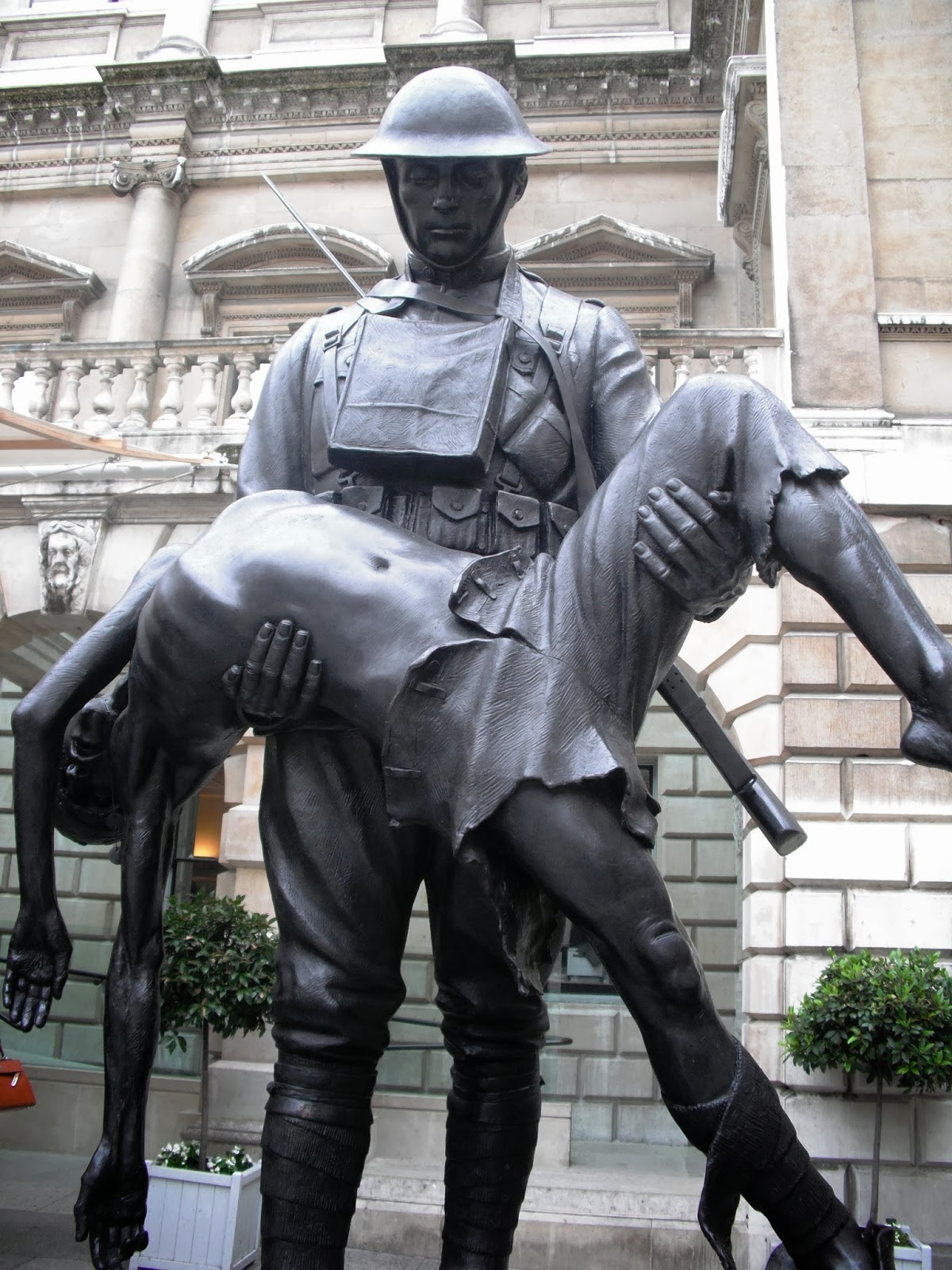
This war memorial, to the fallen of the American ‘Rainbow Division’ catches something of the pathos and tragedy of World War I    

Now, during the centenary year of the outbreak of World War I, Michael Gove urges us to ‘celebrate’ what used to be called ‘the Great War’ and to ignore the ‘left wing intellectuals’ who claim that it was a flagrant and appalling squandering of human life engineered by scheming politicians and made worse by incompetent military commanders driving (but never leading!) masses of unwilling soldiery like sheep to the slaughter.  One doesn’t have to be left-wing or particularly intellectual to accept the remembered testimony of those, now no longer with us, who fought in and survived that war – and the evidence of the World War I cemeteries and war memorials in northern France  and Flanders.

            Probably the most famous war memorial in mainland Europe is the Menin Gate outside Ypres, the only Belgian town that was never under German control during World War I, where some of the bloodiest battles of that war were fought.  Completed in 1927 the Memorial was intended to bear the names of the British and Commonwealth soldiers who were known to have been killed in those battles but whose bodies had  never been found. There were 55,000 such soldiers and, huge as the Menin Gate memorial is, there was found to be insufficient space for 55,000 names. Consequently the Menin Gate has the names of only some 35,000 names and the others are memorialised elsewhere!

            Poet, author and war hero Siegfried Sassoon* (he was awarded the M.C. Military Cross* for his conspicuous gallantry) wrote of the Menin Gate,

Well may the dead, who struggled in the slime,
Rise and deride this sepulchre of crime.

            I reckon that if Siegfried Sassoon were alive today he would say much the same about the  ‘celebration’ of the centenary of the outbreak of World War I.  I and other ex-servicemen survived World War II because military commanders in that war were less careless of human life than their predecessors had been just over two decades earlier.
           
I hope that we will remember the outbreak of World War I with repentance for human folly and wickedness and determination never again to be deceived by scheming politicians into the wholesale slaughter of our fellow men and women. As for Michael Gove – a Biggles Omnibus and a few ancient copies of The Boys own Paper should keep him happy.   Let us hope that he is never in a position to realize his dreams of military glory.

            *Siegfried Sassoon was a volunteer infantry officer who became aware of the criminal waste of human life in World War I and subsequently became a peace campaigner.  His paternal ancestors had been Iraqi Jews and he owed his German Christian name to his gentile mother’s love of Wagner’s music. He was undoubtedly recklessly courageous and was known as ‘Mad Jack’ as a result.  It has been said that OBE sometimes stands for ‘Other B………. Efforts’.  No-one has ever been awarded an M.C. for any efforts other than his or her own.
           
Calling all (or any!) local blog readers

            Such are the wonders of modern technology that I can be pretty confident that there are over 2,000 regular readers of this blog world-wide.  I know that I have many readers in the USA and in Russia as well as in the UK, readers in Germany, Poland, Bosnia and the Ukraine and even a few in India, in mainland China and Vietnam. What I don’t know is whether I have many local readers, from southern East Anglia – in particular from north-east Essex and southern Suffolk.

            I know that I have one or two because they have contacted me – but perhaps that’s the lot.  We have it on the very best of authority that a prophet it less likely to be honoured in his own neighbourhood and among his own people than further afield!  This particular item is especially for all – or any – local blog readers.

            On Sunday 12th January, BBC tv’s Countryfile programme invited viewers to contact them if they felt that a Countryfile programme might possibly be made in their particular area.  These programmes cover local farming but also most other rural activities and interests – particularly where there is local controversy,  such as the tourist development of Dedham Vale for instance.

Bridge Cottage, Flatford Mill         

I have emailed them suggesting the Suffolk/Essex border area; the countryside that inspired Constable and Gainsborough, from Sudbury through Dedham, Flatford Mill and Manningtree to historic Harwich, home of the Mayflower.  Then there’s the rich agricultural land of the almost-an-island Tendring Peninsula, with Walton Backwaters – scene of one of Arthur Ransome’s children’s novels and, on the outskirts, Colchester, England’s oldest recorded town as well as, on the Essex 'sunshine coast', no less than five coastal holiday resorts, each with its own character but all having safe, clean, sandy beaches, ‘all the fun of the fair’ for those who want it and the lowest average annual rainfall in the British Isles;  all easily accessible from London!

                                   The home of the Master of the Mayflower in Harwich        

  I am quite sure that a visit from the Countryfile team and a programme featuring the Essex/Suffolk border would enhance the economy of the whole area and bring us welcome holiday visitors.  Why not respond to the Countryfile appeal and suggest a visit to our region?  Emails should go to countryfile@bbc.co.uk   If you have any photographs of the area send them as attachments.   To my own email I attached a photo of Bridge Cottage, Flatford Mill, and one of the Harwich home of the Master of the Mayflower. Here they are!


09 July 2013

Week 28 2013

Tendring Topics…………on line

Tendring Careline

          On Sunday afternoon, 30th June, I was watching the tv in my living/kitchen when a disembodied voice disturbed me.  ‘Warning!’ it insisted, ‘the telephone is disconnected’.  It emanated from the ‘magic box’ of my Tendring Careline installation sitting unobtrusively on the window-shelf of my sitting room. Tendring Careline is a district council service that for over a quarter of a century has offered security to old or disabled folk living on their own,  I have been signed on as one of its clients for two or three years and recommend it without hesitation to people in a similar situation as myself.

My Careline (magic box) Transmitter/Receiver
positioned on my window shelf.  Beside it is my pendant – placed there solely to be photographed. Two minutes after the photo had been taken it was round my neck again!

The ‘magic box’ incorporates a powerful microphone and loud speaker and is connected to the land-line telephone system.  With it comes a plastic pendant with a red push-button that I wear round my neck at all times.  Should I fall and be unable to get up, become suddenly ill, or should there be any other emergency (a fire, a flood, an intruder!), pressing that red button anywhere in my bungalow and at any time of the day or night, will alert one of the round-the-clock staff at Careline’s Clacton headquarters who will seek to reassure me and take immediate appropriate action.  This might consist of phoning the police, the ambulance service or the fire service or simply asking a neighbour who holds the key to my bungalow to look in and give me a hand.  On the outside wall beside my front door is a ‘key safe’ in which there is a key to front door accessible only by the use of a code number that Careline would give to the emergency service.

            My last week’s emergency wasn’t really urgent by Careline standards, but the fact that my telephone land-line wasn’t working meant that my pressing that potentially life-saving red button would be fruitless.  I could have tried phoning British Telecom myself on my mobile phone but I knew from experience that I’d be answered by a mechanical voice with questions that I would be unable to understand or answer -  ‘Please enter your account number and press one (or possibly 2 or 3) under this, that or the other circumstance’ – for instance!   I thought that if I phoned Tendring Helpline, I would at least reach a helpful and sympathetic human voice – and that if they phoned BT they’d carry more weight than an exasperated ninety-two year old could hope to.

            I was right on all counts.   A very helpful and sympathetic young lady replied to my call. She promised to phone BT on my account and ring back to let me know the result. And so she did.  Fifteen minutes later my mobile phone rang and she told me that BT had several disconnections in my area and that mine would be fixed before lunch time the next day.  It didn’t happen quite like that. Monday lunch time came and went.  The land-line phone was still out of action. At about 3.00 pm I phoned Careline again and a different, but equally helpful and sympathetic young lady assured me that she’d ring BT again and urge them to regard my re-connection as urgent.

            Just before 10.00 pm I thought that I heard a click from my land-line phone.  I lifted the receiver – and there was the familiar and very welcome dialling tone!   I immediately went into the sitting room, pressed that red button on the pendant round my neck (it was after 10.00 pm by then but it is a 24 hour service), told the Careline operator who answered me  that all was now well, and asked her to pass on my thanks to her colleagues.   ‘Just part of the Tendring Careline Service’, she replied. It was really quite a tiny crisis – but to a nonagenarian living alone, even tiny crises can seem enormous.

            I do recommend the Careline service to elderly folk living alone, particularly those who have a degree of disability.  The address of Tendring Careline is Barnes House, Pier Avenue, Clacton-on-Sea, CO15 1NJ and the telephone number is 01255 222727.  The service isn’t free I’m afraid.   The charge if you are exempt from VAT (you should be if you are suffering from a medical condition) is £18.00 a month  (£216.00 a year), or £21.60 a month (£259.20 a year) if you are liable for VAT. That charge includes the loan and installation of the ‘magic box’ and pendant. It’s well worth it if you can afford it.

            Blog readers who live elsewhere in the UK than in the Tendring District will almost certainly find that there is a similar scheme in their area, run either by the local authority or a private firm.  World-wide, I really don’t know the position.

A lone Lib-Dem Voice

          The parliamentary progress of Colchester’s Lib.Dem. MP Sir Bob Russell is always of interest.  If I were a Colchester voter his general support for the Lib/Con coalition government would prevent me from giving him my vote – but I admire the way in which he speaks his mind and is quite prepared to be in a minority of one when his conscience and/or common sense demand it.

            He, alone among Lib.Dem members of parliament, voted against the proposed high-speed rail link between London and the North.   I – and I note many readers of the local Gazette – am sure that he was right to do so.  This proposed rail link is a ‘prestige project that will inevitably take longer and cost more than is currently estimated.  When completed it will be possible to travel ‘up north’ rather more quickly than is possible by rail at present – though less quickly and rather more expensively than by air!

            Meanwhile the same government that is proposing to lavish millions of pounds of our money on this project, is cutting yet again their grants to local authorities; money badly needed, among other things, to fill in our potholed roads and repair our worn, broken and dangerous pavements.

            I am reminded of a story recounted by H.G. Wells of a visit to Russia in the years immediately after the revolution and civil war.  Looking across the Red Square in Moscow he saw an enormous building with a gigantic banner draped across it on which, in Russian Cyrillic capitals, was blazoned the message;  ‘INSTITUTE FOR THE ELECTRIFICATION OF ALL THE RUSSIAS!’

          Walking across the Square to this imposing building he found beside the entrance, a small notice, also of course in Russian; Bell out of order’. 

‘Certainly tries very hard’

          That, I think, would be the words I would write on a report about Michael Gove’s progress as Education Minister in the present coalition government.  He really does try to produce an educational system from which Britain’s sixteen-to-eighteen year olds can emerge literate, numerate, with at least a rudimentary acquaintance with science, the history and geography of the world and in particular their own country, a familiarity with their own country’s literature and some knowledge of at least one foreign language.  It seems a great deal, but then the educational system does have 13 years in which to achieve that end, and they are the 13 years in which our ability to learn is at its highest.   More recently Mr Gove has set himself a rather more modest task; that of teaching the Civil Servants of the Department of Education to write literate, straightforward and grammatical letters and reports.  That surely doesn’t seem too much to ask.  He has circulated a memorandum containing ten points that they should observe when composing such a piece of prose.

            Some of the advice is unquestionably very sound.  When in doubt, cut it out. Read it out loud – if it sounds wrong don’t send it.  The more a letter reads like a political speech the less good it is as a letter. Would your mum understand that word, phrase or sentence?  Would mine? Isn’t that just a little patronising?  My mum (born in 1888) left a village school to go ‘into service’ at the age of 12.  As an adult she could write literate, grammatical and correctly spelt letters, had a knowledge of history and geography greater than that of many school leavers today, and she was familiar with the plots, and several of the speeches, of some of Shakespeare’s best-known plays.  Other advice that I would have added would have been:  Try to write short sentences.  If a long sentence can be made into two short ones, do it.  Short paragraphs are also to be preferred. A large unparagraphed block of print discourages the reader.   Try to begin the letter ‘Dear Mr Smith’ or whatever.  We all like our own name and we all hate being addressed as ‘Dear Sir or Madam’.

 Mr Gove suggests too that to improve their own prose his staff should read the work of great writers, suggesting George Orwell, Evelyn Waugh, Jane Austen, George Eliot, Matthew Parris and Christopher Hitchens.  I’d certainly agree with George Orwell, Jane Austen and George Eliot, but how about Charlotte Bronte?   Parris and Hitchens are both political writers.  I’d suggest replacing them with P.G. Wodehouse and Raymond Chandler, creator of ‘private eye’ Philip Marlowe.  They were both educated at Dulwich College, where there must have been a first class English Department.  They were both masters of written English (American-English in the case of Chandler) and both, though in very different ways, provide an enjoyable and page-turning read for even the most philistine civil servant.


02 April 2013

Week 14 2013


Tendring Topics……on line

A Second ‘Mrs Thatcher’?

The ‘Right to Buy’   

According to some sections of the press the promise in the Chancellor’s Budget  that the government will step in to guarantee a large proportion of the deposit currently required by Banks and Building Societies before they will grant a mortgage for house purpose, will help thousands to realize their home ownership dreams.   In furthering the cause of home ownership for all it is, so they say, comparable with Mrs Thatcher’s bold move in offering the right to buy their homes (at bargain basement prices) to all Council House tenants.

            I certainly hope not. Right to buy was surely a flagrant (and sadly probably very effective) example of buying votes with other people’s money.  It was made worse by the fact that the ‘other people’ whose money bought those votes were far-sighted Borough or District Councils that had invested in Council dwellings to ensure (or so they thought!) that there would never be homelessness or overcrowding in their areas, and that local young people who weren’t sufficiently well off to buy their homes would be able to move into a rented houses in the vicinity of friends and family.   It was significant that there was never any suggestion that the right to buy should be extended to include tenants of privately owned properties. The owners of those properties were likely to be supporters of Mrs Thatcher’s Party!

The Consequences of ‘Right to Buy’
           
As for the effects of right to buy; well, it certainly improved the fortunes of quite a few middle-aged people who seized the opportunity of, ‘helping poor old dad (or mum) buy his own home’, at a ridiculously low price. ‘At eighty-five he’d have never managed it on his own’,   Of course, they made sure that poor old dad left them the house when he departed.  They then sold it at its proper price immediately they were able to do so, making a very comfortable profit.

            Many urban council housing estates started degenerating into slums as the ‘best tenants’ bought ‘the best houses’, selling them at a profit when they could and moving on. Many other council tenants bought their homes and found that, even though the purchase price had been low, they were having difficulty keeping up the mortgage repayments, plus having to pay Rates (now Council Tax) and Water Rate and carry out regular painting and maintenance.

            It was though in rural village communities that the right to buy had its most malign effects. Council houses and bungalows in such areas tend to be built in small groups, infilling available space, and merging into the village scene.  These were quickly bought up by astute tenants, eventually either selling them or passing them on to their sons or daughters who had no trouble at all selling them on at inflated prices – in some cases as rural ‘second homes’.   Thus, councils were building no more houses to let and no longer had ‘casual vacancies’ as tenants died or moved away.   Young couples whose families had lived in village communities for generations, perhaps centuries, found themselves unable to make their homes there.  Meanwhile, house price inflation soared as ‘townees’, seeking second homes or rural homes from which to commute to the city, snapped up any rural property becoming vacant.  Village communities died and degenerated into dormitories for city workers as village shops, pubs and churches closed.

39 Byng Crescent, Thorpe-le-Soken. A rural council house where Heather and I were happy to live temporarily in 1955, and where our second son was born.                  

One of the more idiotic statements made by Ed Miliband as leader of the Labour Party was his apology for the Party’s opposition to right to buy, way back in the 1980sHe should, on the contrary, have been apologising for the Party’s failure to repeal the legislation when, during the following decade, it had the opportunity to do so.

          Will George Osborne’s proposal to lend would-be house buyers a large proportion of their deposit, have the same disastrous results as Mrs Thatcher’s right to buy.  I hardly think so but, inspired by the same mirage of home ownership for all that blinded the Conservative government of the 1980s, it is likely to create disasters of its own.

House Purchase – then and now
           
Heather and I with our two young sons outside our bungalow in November 1957.  We had been home-buyers for just a year.    

Is this, for instance, a sensible time for anyone to be taking on a long-term loan for house purchase?   When, in 1956, my wife Heather and I began the purchase of the bungalow in which I am typing these words, I was thirty-five years old and a qualified Public Health Inspector with ten years experience.  I had just been appointed as a PHI by the then Clacton Urban District Council.  The mortgage loan was repayable over twenty-five years (in fact my spare-time freelance writing enabled us to pay it back in fifteen!) and I had every reason to believe that, unless I did something criminal or utterly stupid, I would stay in the same or similar employment for the whole of that time.


How many junior public officials nowadays can be confident of retaining their employment and being able to repay a similar loan over twenty-five years?  No job is really secure.  There’s no longer such a thing as a job for life.  During those pay-back years we would have described ourselves as home-owners. We weren’t really though.  Until we made that final payment and the Building Society returned to us the deeds of our bungalow, they were the true owners and we were only the home-buyers.  David Cameron has waxed lyrical about the pride and joy of receiving the house key and moving into your own home.  He’s right, of course. But he should also have given some thought to the shame, dismay and despair of being evicted from what you had thought was your own home, because – through no fault of your own – you could no longer keep up the mortgage payments.

            Then again, do you remember what triggered the current economic depression?   There was a housing boom.  House prices went up and up, way above the rate of general inflation.  Building Societies were eager to lend.  They no longer bothered about the credit-worthiness of applicants for a mortgage.  The steadily increasing price of houses made them believe that they were betting on a good thing even if the purchaser defaulted on his payments.  They were offering loans of 95 percent or 100 percent of the purchase price, sometimes throwing in an extra few hundred for moving-in expenses.   And then…….the bubble burst.  House prices dropped, Britain went into recession, and those loans were anything but secure.

What goes around comes around!’

            Banks and Building Societies had learned their lesson.  They weren’t going to be caught out like that again.   There were to be no more 95 and 100 percent mortgages. Deposits of 20 percent and more of the value of the house were demanded.  There was, and is, a housing shortage.  Unable to find the deposit, home-seekers looked to the rental market.  Social housing had become only for the virtually destitute. Private house owners put up their rents.  Not a penny of that Housing Benefit with which the government parts so reluctantly, stays with the actual recipients.  It goes straight into the pockets of rapacious landlords taking advantage of uncontrolled market forces.

            Now, thanks to this bright idea of clever Mr Osborne, the government is going to rush in where banks and building societies have learnt to tread with extreme care.  They are going to help by guaranteeing a large proportion of those high deposits.  Can they really not see that they are manoeuvring themselves into the same position that existed before the housing bubble burst?  The only difference is that it is the government’s money (our money!) that is being put at risk this time.

            The government’s offer will increase the number of potential home buyers –but there will, at least for some considerable time, be no corresponding increase in the number of new homes on the market.  Those all-powerful market forces will force up house prices again – and again – until once more the bubble bursts!  As Stan Laurel (or was it Oliver Hardy?) used to say ‘Now look what a muddle your right to buy and home ownership for all have got us into!’

The Teaching of History

            No regular reader of this blog is likely to accuse me of being an uncritical admirer of our present government and its members.  Yet I have to confess to having some sympathy for Mr Michael Gove, Education Minister.  He is painfully aware of the fact that there’s something wrong with Britain’s Education System (if you doubt this, watch any popular quiz show on tv and note the encyclopaedic knowledge of sport and pop music and the abysmal ignorance of virtually everything else) but his every attempt to do something about it provokes anger and derision from the teaching profession.   His ideas on the teaching of history go back, so they say, to the 1920s and 1930s.  His critics are quite convinced that in those unenlightened days, History Lessons consisted of learning, by rote, dates of kings and queens and the battles in which they were involved.

             Well, I was at school from the late ‘20s to the late ‘30s and my History Lessons weren’t a bit like that. They were exciting.   From our very first years at school, we learned something about Egyptian and Greek civilisation at a time when Western Europe was sunk in barbarism, about the Roman Empire, the Roman invasion and occupation of Britain and that empire’s eventual collapse.  As we progressed we moved on to learning about the Anglo-Saxon invasion and settlement of Britain, followed by the Vikings and eventually the Normans.  As we grew older we learned rather more about all these events and how they happened.  The Dark Ages were followed by the Middle Ages, the Renaissance and the Industrial Revolution.  We learned about the great Empires that succeeded the Romans – the Ottoman Empire, the ‘Holy Roman Empire’, and those of Spain, Portugal, France and ourselves.  In the 1930s the British Empire was, of course, still intact.   

            This narrative, that made sure we all realized how and in what order each event led to its successor, was lightened by colourful, sometimes legendary, stories about events of the past;  King Alfred burning the cakes,  the Burghers of Calais, Henry VIII’s six wives, the martyrdom of Cranmer, Latimer and Ridley,  Raleigh spreading his cloak over a puddle so that Queen Elizabeth could walk on dry-shod, Drake finishing his game of bowls before sailing out to meet the Spanish Armada, the Speaker of the House of Commons defying King Charles I and so on.  They all helped to make us feel that history was about real people like ourselves.  In those days ‘school history’ ended with the Causes of the Great War (we didn’t, of course, call it World War I because we didn’t know there was going to be a World War II!)  Those like myself, who were studying history for the General Schools Examination (the Matric) spent two years studying one particular period of history in greater detail.   My class studied British, European and World History from 1815, the end of the Napoleonic Wars, to 1914 – the beginning of the Great War.

            It was an action-packed century.  There were wars, in many of which we were involved, among them Crimea, two Boer Wars, Sudan, the Indian Mutiny, and two failed attempts to control Afghanistan (pity our present politicians hadn’t studied those more closely!)  There were others in which Britain was not involved; American Civil War,  Austro-Prussian War, Franco-Prussian War, and wars of liberation in Latin America.  It was a century of nationalism with the unification of both Germany and Italy. It was a century of social unrest – the birth of the Trade Union movement the Labour Party and of the Christian Social Movement.  It was the century of the Chartists and of Karl Marx; when even Benjamin Disraeli, founder of the Conservative Party was briefly a ‘Radical’!  It was a century of ‘dark, satanic mills’, slums, and cholera epidemics, but it was also a century of Parliamentary Reform, of Education, Factories and Public Health Acts.  A great many good, and evil, aspects of life in the third millennium saw their beginnings during the 19th Century.

            I reckon that we could do a lot worse than return to the History teaching of the 1920s and 1930s.  The fact that, after well over seventy years, I remember so much of it surely suggests that they must have got something right in those days!


26 September 2012

Week No 39 2012

Tendring Topics.....on line


What goes around, comes around!’

 Michael Gove’s idea of an English Baccalaureate having English, Maths and a Science as compulsory subjects, with assessment of pupils dependent upon an examination taken at the end of the years of secondary education, without ‘modules’ and without course-work being taken into consideration, has been condemned by some of its opponents as ‘going back to the ‘80s’.   I would have been inclined to say that it was going back fifty years earlier than that, to the 1930s and would have been inclined to add, ‘and is none the worse for that!’

            I can see little, if any, difference between Mr Gove’s proposals and the examination that I took in 1937 at the age of sixteen, before leaving school at the end of my secondary education   Our exam was not called a Baccalaureate (though I remember our French master telling us that that was the name of the equivalent exam taken by school leavers in France) but the London University General Schools’ Certificate examination.  To gain that certificate we had to study and pass an exam in at least five subjects which had to include English (grammar and literature), Mathematics (arithmetic, algebra, geometry and trigonometry) a Foreign Language and a Science.   I think that most of us took six subjects – the only Foreign Language taught at my school was French, and my other subjects were History, Geography and General Physics.  The last of these was reckoned to be the scientific ‘soft option’ as it was guaranteed to be about scientific principles only and to have no mathematical questions! 

The pass mark was 40 percent.  Those who achieved this mark in the four compulsory subjects plus one other, passed the exam and gained the certificate.  Failure in any one of those subjects meant failure in the whole exam.   Those who gained at least 50 percent marks in the compulsory subjects and one other subject, were awarded ‘Matriculation Exemption’.  Matriculation was the admission examination to London University.   We all aimed at ‘the Matric’ (and that’s what the exam was often called) and I was successful.  Very few of us though even considered the possibility of going to London or any other University.  In those days Universities were not for ‘the likes of us’ working class kids.

            Possession of that General Schools Certificate, especially with the added ‘Matric Exemption’ was the key to a ‘white collar’ job and perhaps the first step towards qualifying for a minor profession.  I would certainly not have been appointed to my first job as Junior Clerk/Student Sanitary Inspector (nowadays they’re called Environmental Health Officers) with Ipswich Council’s Public Health Department without it.  My school studies had been tilted away from the sciences, but my very creditable pass in ‘General Physics’ helped me secure that job and, many, many years later the basic knowledge of science that I had acquired at school certainly helped me to write half a dozen commercially successful books on domestic hot and cold water supply and drainage!

            There are two myths (at least!) about Michael Gove’s proposals that need to be exploded.  The first was one that I heard put forward by a representative of the NUT on tv this (18th September) morning.  This was that children, having had no previous experience of exams, would be suddenly faced with a vital life-changing one at the age of sixteen.   That simply wasn’t true in the ‘30s and doesn't have to be true today. At the end of every term at my secondary school we had written examinations taken under ‘exam conditions’ in every subject that we had studied. The results of these exams were included in an end-of-term report to our parents.  They also received a half-term report usually based on informal tests to which we had been subjected.  That surely was true ‘continuous assessment’ – and not just the teacher’s opinion.

            At the end of the term prior to taking the General Schools’ Certificate exam we had a ‘mock exam’, usually consisting of questions from previous General Schools’ exams.  From this, pupils, parents and teachers could get a good idea of the likely results in the real examination a couple of months later.

            The second myth is that children would swot away during the months, days, hours, before the final exam and would fill their heads with material that would disappear from their memories within days!


The Stour at Bridge Cottage, Flatford Mill, in the heart of the ‘Constable country’, where we exam candidates relaxed on the day before our exam ordeal began.  Under the wooden foot-bridge can be seen two of the skiffs that our school hired for the day. Bridge cottage once belonged to painter John Constable's father.         

That certainly didn’t happen in my school, the Northgate Secondary School for Boys in Ipswich.  Quite apart from the continuous assessment from end-of-term examinations, our Headmaster (Mr Alfred Morris) had a very strong dislike of ‘last minute swotting’.  He established a tradition that on the day before sitting for the first session of the General Schools’ Certificate exam all candidates would cycle (we all rode bicycles in those days!) from Ipswich to Flatford Mill where we would spend the day boating on the Stour, finally rowing up river to Dedham where we would enjoy a communal tea in one of the restaurants there.  We each took our own packed lunch but the school paid for the hire of the skiffs and for the tea!  Many of us took the exam next day with aching backs and blistered hands but, for all that, the results were usually pretty creditable.

A criticism of Michael Gove’s proposal is that there’s nothing in it for academic ‘low achievers’.   They, so it is said, are set up for failure.   Perhaps so – but if the exam were to be in carpentry or practical electrics, or in any other activity requiring manual dexterity I, and many others like me, would also be set up for failure.  At school my total uselessness at every outdoor game and sport (except swimming) also set me up for failure – and derision! Don’t blame education. Blame a social and economic system that generally rewards ‘white collar activities’ (particularly in the field of finance) much more generously than even the most highly skilled manual work.

I found my secondary education and its culminating examination of great value to me in later life.  My two sons, educated in the ‘60s in the days of ‘O’ levels found the same.  No regular reader of this blog is likely to accuse me of being an uncritical admirer of the present government.  The words mendacious incompetents spring to mind! Nor do I share Mr Gove's enthusiasm for 'academies' and 'free  schools' - free that is from local democratic control, but firmly under the thumb of central government. He who pays the piper calls the tune!'

 I do think though that there is merit in Michael Gove’s plans for secondary education, even if they are nearly eighty years old!   It is strange to find myself on the same side as the Mail, the Sun and the Telegraph rather than the Independent and the Guardian, but there it is.  I remember Polonius’ advice to his son Laertes in Shakespeare’s Hamlet:  ‘This above all, to thine own self be true’. It is advice that I do try to follow.

Policing the Police!

          Overseeing the operation of Britain’s Police Forces at the present moment are Police Committees, thoroughly undemocratic bodies that appear to be answerable to no-one but themselves. They need to be reformed, and since Police Force boundaries generally coincide with those of a local authority (either county or borough council) an obvious solution might have been to hand over their functions to the appropriate local authority.   That however is not the path that the Government has chosen.   They intend to have each Police Force under the wing of a single directly elected Commissioner – to be elected by us on 15th November of this year!

           These Commissioners, says the government’s official web site, will aim to cut crime and deliver an effective and efficient police service within the force area. They will do this by:

·                            holding the chief constable to account for the delivery of the force
·                            setting and updating a police and crime plan
·                            setting the force budget and precept
·                            regularly engaging with the public and communities
·                            appointing, and where necessary dismissing, the chief constable
It will not be for the PCC to tell the professionals how to do their job - the legislation continues to protect the operational independence of the police by making it clear that the chief constables retain direction and control of the forces officers and staff. The operations of the police will not be politicised; who is arrested and how investigations work will not become political decisions.
            Do you fancy the job?  There’s no mention of the salary on the web site but I reckon it’ll be well worth having!  You’re not eligible if you have ever been convicted of an imprisonable offence, if you are a civil servant or are employed by a local authority in the Police Authority area (for Tendring District residents that means within the county of Essex).  Otherwise the field is open  to any registered voter in that area except that you’ll need to find another 100 registered voters to nominate you and you’ll have to hand over a deposit of £5,000 that will be forfeited if you don’t attract at least 5% of the votes cast.   Candidates may be independent or the nominees of a political party.

            There are currently six prospective candidates for our Essex area, three male and two female, three the nominees of political parties – Conservative, Labour and English Democrat, and three Independents.   Nominations cannot be made before 8th October or after 19th October.

            I shall undoubtedly vote, though I’ll need to know a lot more about each candidate before deciding to whom my vote will go. It is unlikely that it will be for one of the party nominees.  I would have preferred the Commissioner to have been advised by a directly elected committee but, since this isn’t going to happen, I shall want him or her to be truly independent; without, for instance, being subject to this kind of pressure: ‘Of course it’s your decision to make, no question about it, but - if you hope to retain Party support when it comes to re-election - you’ll………….

            This November election has a feature that some may find surprising.  You remember that referendum we had last year that firmly rejected the idea of listing parliamentary candidates in order of preference, in favour of ‘one man, one vote’ and ‘first past the winning post wins’?   Well, voting for our Police and Crime Commissioner won’t be on a ‘first past the post’ basis. We are to be invited to indicate our first and second choices, the second choice to be taken into account if the winner doesn’t get an overall majority; much the same, in fact, as the system for which I voted in that referendum but that was decisively rejected by a comfortable majority!